

• Contact us
  • E-Submission
ABOUT
BROWSE ARTICLES
EDITORIAL POLICY
FOR CONTRIBUTORS

Page Path

5
results for

"communication"

Filter

Article category

Keywords

Publication year

Authors

Funded articles

"communication"

Articles

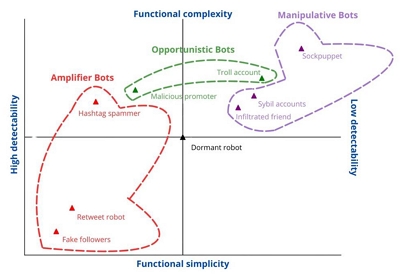
This article examines how social robots, or “bots,” have transformed online interactions and information manipulation, particularly on the platform X (formerly Twitter). It retraces their socio-historical evolution—from early chatbots like ELIZA to AI-driven agents capable of realistic human mimicry. Drawing on the Beelzebot research project, the paper proposes a classification of “malicious” bots according to their technical sophistication, intentionality, and interaction strategies. These bots amplify, polarize, and distort public debate through mechanisms such as astroturfing, fake engagement, and echo-chamber exploitation. The integration of generative AI has produced a new generation of adaptive, persuasive “AI bots” blurring human-machine boundaries. The article highlights how these entities shape information flows, foster disinformation, and undermine trust in institutions. It argues for a socio-technical “archaeology” of bots to understand their evolving power in digital public spaces. Finally, it calls for new multidisciplinary tools—technical, educational, and regulatory—to preserve the authenticity of social interaction and democratic deliberation in the AI era.
  • 12 View
  • 1 Download
Artificial Intelligence for Intelligent Road Communication: Systems and Strategies in Cameroon
Myriam Josette Nken
EPISTÉMÈ 2025;36:46-59.   Published online December 31, 2025
DOI: https://doi.org/10.38119/cacs.2025.36.3
Road safety in Cameroon remains a major concern, with thousands of deaths and significant economic losses recorded annually. Traditional road communication strategies have shown limited effectiveness, revealing a gap between the messages disseminated and their appropriation by road users. In this context, artificial intelligence (AI) emerges as a strategic resource to rethink prevention and traffic regulation. Intelligent Transport Systems (ITS) and digital tools such as navigation applications, smart sensors, and connected vehicles provide new opportunities for interactive, predictive, and adaptive communication. The study adopts an empirico-inductive methodology based on observation, documentary analysis, and international comparison. The theoretical framework combines Shannon and Weaver’s mathematical theory of communication, Habermas’s theory of communicative action, Crozier and Friedberg’s sociology of regulation, and ITS approaches. The analysis highlights both media and non-media strategies, while demonstrating the concrete contributions of AI to traffic fluidity, accident reduction, and road governance. It concludes with the challenges and prospects of implementing intelligent road communication adapted to the Cameroonian context.
  • 639 View
  • 53 Download

This paper aims to look into possibilities of future writing in the age of artificial intelligence. ‘Who writes’ matters in a technological culture of co-existence of humans and machines. I thus investigate the aligned questions of ‘why we write’ and ‘how we write’, exploring writing with imagination, namely, narrative writing, for communication and transmission. As for methodology, I examine three domains of narrative with imagination based on Peirce’s metaphysical semiotics and Paul Ricoeur’s imagination theory: esthetics with oneiric imagination, poetics with narrative/analogical imagination, and speculative rhetoric with social imagination. I argue that narrative communication with social imagination which comprises an explanatory narrative process of quality through fact to representation for dialogic abduction is geared toward discovering self’s identity by means of re-authoring conversation. This thus results in enhancing a communal narrative self to transmit virtues and values to the following generations.

  • 885 View
  • 31 Download
Artificial Intelligence in Healthcare: A Holistic Approach for Successful, Human-Centered Implementation
Emmanuel Carré, Marjorie Garofalo
EPISTÉMÈ 2025;33:6.   Published online March 31, 2025
DOI: https://doi.org/10.38119/cacs.2025.33.6

The integration of Artificial Intelligence (AI) in the healthcare sector represents a major transformation that raises complex issues concerning the technical, organizational, and relational dimensions of the profession. This contribution analyzes the key success factors and obstacles to the implementation of AI in healthcare facilities, adopting a holistic perspective that emphasizes communicational and interprofessional dynamics. Through an analysis of recent literature, we identify promising approaches and necessary conditions for successful AI integration, while preserving the quality of caregiver-patient relationships and interactions among professionals. Our analysis reveals that successful implementation relies on a balanced combination of leadership, end-user training, support for teams in modifying their daily work, and ethical governance. The central role of communication in this transformation process is emphasized, both in change management and in the adaptation of professional practices. We propose recommendations that integrate these different dimensions to guide the development and implementation of AI projects in healthcare, focusing on preserving and enriching human relationships within healthcare organizations.

  • 677 View
  • 25 Download

기타인문학

This article offers an initial sketch of a model, semio-pragmaticism, whose ambition is to enable communication studies to be (re)founded on a common paradigmatically pragmatic and operationally semiotic foundation. Beginning with a review of various currents of thought in CIS and related disciplines that share this pragmatic concern for (re)placing the (communicational) subject at the center of the analytical approach to communication, I propose, on this basis, a fundamental synthetic model of communication conceived from and for the understanding of the communicational subject as the necessary and sufficient yardstick for the understanding of communication.

Citations

Citations to this article as recorded by  
    • 952 View
    • 1 Download
    • 1 Crossref
    TOP