

• Contact us
  • E-Submission
ABOUT
BROWSE ARTICLES
EDITORIAL POLICY
FOR CONTRIBUTORS

Page Path

17
results for

"IA"

Filter

Article category

Keywords

Publication year

Authors

Funded articles

"IA"

Articles
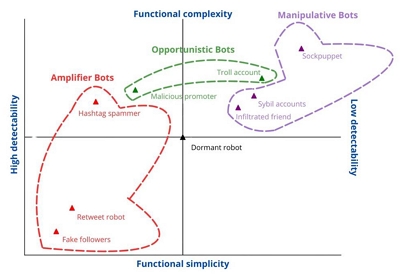
This article examines how social robots, or “bots,” have transformed online interactions and information manipulation, particularly on the platform X (formerly Twitter). It retraces their socio-historical evolution—from early chatbots like ELIZA to AI-driven agents capable of realistic human mimicry. Drawing on the Beelzebot research project, the paper proposes a classification of “malicious” bots according to their technical sophistication, intentionality, and interaction strategies. These bots amplify, polarize, and distort public debate through mechanisms such as astroturfing, fake engagement, and echo-chamber exploitation. The integration of generative AI has produced a new generation of adaptive, persuasive “AI bots” blurring human-machine boundaries. The article highlights how these entities shape information flows, foster disinformation, and undermine trust in institutions. It argues for a socio-technical “archaeology” of bots to understand their evolving power in digital public spaces. Finally, it calls for new multidisciplinary tools—technical, educational, and regulatory—to preserve the authenticity of social interaction and democratic deliberation in the AI era.
  • 12 View
  • 1 Download
This article examines religious hate speech as a discursive technology that constructs adversaries through conceptual antinomies, enabling moral disengagement and legitimising exclusion or violence. It draws on interdisciplinary perspectives from philosophy, law, sociology, and theology and discusses significant cases—including the Northern Ireland Troubles, ISIS propaganda, Hindu extremist rhetoric against Christians, and Buddhist ultranationalism against Rohingya Muslims—demonstrating how religious identities intersect with other factors to create hostile narratives. The article explores definitional challenges, distinguishes hate speech from incitement to genocide and blasphemy laws, and examines US and European legal approaches. It reveals that hate speech produces multilayered harms affecting individuals, targeted groups, and democratic processes, with causal factors including ideological antinomies, political manipulation, and social media amplification. The study argues that combating religious hate speech requires moving beyond punitive criminal law to embrace restorative justice, interfaith solidarity, counter-speech initiatives, and educational programs. Only through multifaceted collective efforts can societies preserve democratic values and protect vulnerable populations from discrimination and marginalization.
  • 20 View
  • 2 Download
In this paper, I am concerned with three key questions: 1. Why are the values of humility, compassion, and justice so essential and destabilizing in interfaith dialogues, especially in times of peace? 2. Why should teaching interfaith dialogue always provide space for the grievances on all sides from past, present (and possibly) future unrest and conflict? 3. How do interfaith dialogue participants in post-conflict settings balance the desire and need for justice with compassion and humility for one’s self, one’s community, and the community in conflict? To begin to answer these questions, I will first reflect upon the role, limits, and relationships between these three virtues before turning to the aims and goals of teaching these virtues in the context of interfaith dialogue. At issue is whether the failure to embody compassion and humility through interfaith dialogue in times of relative peace and prosperity signal the impossibility or meaninglessness of such dialogue when passions are rife, stakes are high, and vulnerability, rage, and hopelessness abound.
  • 19 View
  • 4 Download
Augmented Hyperreality: When Artificial Intelligence Completes Baudrillard's Analysis
Emmanuel Carré
EPISTÉMÈ 2025;36:60-66.   Published online December 31, 2025
DOI: https://doi.org/10.38119/cacs.2025.36.4
In 1981, Jean Baudrillard described the entry into the era of hyperreality: the image no longer represents reality, it precedes and produces it. Forty years later, generative artificial intelligence fulfills and surpasses this prophecy. Hyperreality is no longer merely a collective condition imposed by mass media—it becomes a personal device: everyone can now instantly produce their own simulacrum. This text analyzes three anthropological mutations provoked by this democratization. Ontology becomes reversible: AI authentically performs the human (Flynn, an artificial student in Vienna) while humans are suspected of being machines (the NPC effect). Emotion becomes an interface: empathetic chatbots shape what we accept to call "listening," and humans externalize the formatting of their emotions to algorithms. Existence becomes optional: fake-lives (starter packs, Strava Jockeys, fake Chinese offices) industrialize identity performance while feeding the surveillance capitalism theorized by Shoshana Zuboff. The article finally explores the ultimate inversion: we no longer merely simulate reality, we actively transform it to match the figurative. Cities Disneyland themselves for Instagram, bodies are surgically modified to resemble digital filters. The territory becomes the map.
  • 1,153 View
  • 58 Download
Artificial Intelligence for Intelligent Road Communication: Systems and Strategies in Cameroon
Myriam Josette Nken
EPISTÉMÈ 2025;36:46-59.   Published online December 31, 2025
DOI: https://doi.org/10.38119/cacs.2025.36.3
Road safety in Cameroon remains a major concern, with thousands of deaths and significant economic losses recorded annually. Traditional road communication strategies have shown limited effectiveness, revealing a gap between the messages disseminated and their appropriation by road users. In this context, artificial intelligence (AI) emerges as a strategic resource to rethink prevention and traffic regulation. Intelligent Transport Systems (ITS) and digital tools such as navigation applications, smart sensors, and connected vehicles provide new opportunities for interactive, predictive, and adaptive communication. The study adopts an empirico-inductive methodology based on observation, documentary analysis, and international comparison. The theoretical framework combines Shannon and Weaver’s mathematical theory of communication, Habermas’s theory of communicative action, Crozier and Friedberg’s sociology of regulation, and ITS approaches. The analysis highlights both media and non-media strategies, while demonstrating the concrete contributions of AI to traffic fluidity, accident reduction, and road governance. It concludes with the challenges and prospects of implementing intelligent road communication adapted to the Cameroonian context.
  • 639 View
  • 53 Download
Generative AI confronts semiotics with a new kind of sign-producing machine that actively reshapes the production and interpretation of visual content. Addressing the lack of humanities-based transdisciplinary research on this transformation, this study aims to establish a methodological foundation for the semiotic analysis of multimodal AI. By combining visual, social, quantitative, and multimodal semiotics, the paper proposes an integrated micro–meso–macro framework for evaluating AI-generated images. The analysis moves from the micro-level examination of plastic features and text-to-image translation, through the meso-level of enunciation, narrativity, and causality, to the macro-level of social stereotypes, ideology, creativity, rhetoric, truth, and inference. This is supported by a case study on lonely death and a semiotic explanation of latent space.
  • 695 View
  • 19 Download
Semiotics of Fashion: Desire and Resistance, All Things Considered
Giulia Adriana Ceriani
EPISTÉMÈ 2025;34:2.   Published online June 30, 2025
DOI: https://doi.org/10.38119/cacs.2025.34.2
This reflection aims to explore the foundations, limitations, and necessity of fashion semiotics, beyond the inertia that still binds it to a mere reinterpretation of Barthesian legacy. On the contrary, fashion semiotics reveals its compelling and contemporary relevance when it is considered in light of the explanatory power granted to a language too often relegated—for commercial reasons or societal conventions—to a marginal or reductionist role, rather than being acknowledged as an active part of present-day expression in all its forms. These include, notably, gender relations, political implications, the dynamics of possible and impossible relations in the context of digital interfaces, the dialectic between conjunctive tensions and the condemnation to disjunction. Desire and resistance will be the two key terms guiding us through this unaligned reinterpretation.
  • 544 View
  • 13 Download
Fashion Semiotics: State of the Art
José María Paz Gago
EPISTÉMÈ 2025;34:1.   Published online June 30, 2025
DOI: https://doi.org/10.38119/cacs.2025.34.1
Once the failure of classical fashion Semiotics (1960-1980) was certified, as it conceived the fashion phenomenon as a system devoid of meaning (Barthes), incapable of communicating (Lotman) and unbearable (Volli), the great designers and marketing strategists began a new period, that of the Pragmatics of Fashion (1980-2000), committed to resemiotizing the system by resorting to prestigious referents for their collections (the history of art and culture) and to the brand, defined as a hypericonema loaded with powerful literal, imaginary and psycho-emotional meanings (Paz Gago). This stage of fashion semiotics is described by Floch and Calefato, scholars of fashion brands as written text, since it is the proper name of the great fashion designers that has become a brand. Both agree on the need to move beyond the more linguistic stage of the discipline to develop a visual semiotics or a plastic semiotics that serves to analyze fashion as an essentially visual phenomenon. With the new millennium, in line with the new digital technologies that colonize and are colonized by fashion, the Neosemiotics of fashion (2000-2020) emerges, mediated by the stories and reels uploaded to social networks such as Instagram or TikTok, as Bianca Terraciano or Victoria Nannini will analyze. Fashion semiotics faces a new challenge today due to the emergence of Artificial Intelligence, which has already colonized all processes in the fashion system: design creation, pattern making, manufacturing, advertising and marketing campaigns, fashion shows, distribution, and marketing can all be implemented through generative Artificial Intelligence applications. These new technological phenomena respond to the semiotic mode I have called Machination, as opposed to the Representation and Simulation characteristic of classic analog and digital technologies.

Citations

Citations to this article as recorded by  
  • Semiotics of the Manila Shawl (mantón de Manila): From Historical Transformations to its Present Identity Function
    Ana Velasco Molpeceres, Carmen Baniandrés, María Prieto Muñiz
    EPISTÉMÈ.2025; 35: 2.     CrossRef
  • 4,926 View
  • 143 Download
  • 1 Crossref

This paper aims to look into possibilities of future writing in the age of artificial intelligence. ‘Who writes’ matters in a technological culture of co-existence of humans and machines. I thus investigate the aligned questions of ‘why we write’ and ‘how we write’, exploring writing with imagination, namely, narrative writing, for communication and transmission. As for methodology, I examine three domains of narrative with imagination based on Peirce’s metaphysical semiotics and Paul Ricoeur’s imagination theory: esthetics with oneiric imagination, poetics with narrative/analogical imagination, and speculative rhetoric with social imagination. I argue that narrative communication with social imagination which comprises an explanatory narrative process of quality through fact to representation for dialogic abduction is geared toward discovering self’s identity by means of re-authoring conversation. This thus results in enhancing a communal narrative self to transmit virtues and values to the following generations.

  • 885 View
  • 31 Download
AI and the sacred: an anthropological approach
Emmanuel Carré, Pascal Lardellier
EPISTÉMÈ 2025;33:7.   Published online March 31, 2025
DOI: https://doi.org/10.38119/cacs.2025.33.7

This two-part article analyzes the ancient and mystical origins of artificial intelligence (AI). First, it explains that AI has precedents in mystical thought and finds relevance in certain anthropological concepts. Next, we'll look at how ancient philosophy has helped to explain in advance the way in which we - and in particular students - use artificial intelligence as a “mental orthosis”.

  • 1,817 View
  • 25 Download
Artificial Intelligence in Healthcare: A Holistic Approach for Successful, Human-Centered Implementation
Emmanuel Carré, Marjorie Garofalo
EPISTÉMÈ 2025;33:6.   Published online March 31, 2025
DOI: https://doi.org/10.38119/cacs.2025.33.6

The integration of Artificial Intelligence (AI) in the healthcare sector represents a major transformation that raises complex issues concerning the technical, organizational, and relational dimensions of the profession. This contribution analyzes the key success factors and obstacles to the implementation of AI in healthcare facilities, adopting a holistic perspective that emphasizes communicational and interprofessional dynamics. Through an analysis of recent literature, we identify promising approaches and necessary conditions for successful AI integration, while preserving the quality of caregiver-patient relationships and interactions among professionals. Our analysis reveals that successful implementation relies on a balanced combination of leadership, end-user training, support for teams in modifying their daily work, and ethical governance. The central role of communication in this transformation process is emphasized, both in change management and in the adaptation of professional practices. We propose recommendations that integrate these different dimensions to guide the development and implementation of AI projects in healthcare, focusing on preserving and enriching human relationships within healthcare organizations.
  • 677 View
  • 25 Download
Grammatology in the Era of Digital Writing
Hidetaka Ishida
EPISTÉMÈ 2025;33:4.   Published online March 31, 2025
DOI: https://doi.org/10.38119/cacs.2025.33.4

This paper investigates Jacques Derrida's notion of grammatology in the context of contemporary digital writing technologies. It critically reassesses Ferdinand de Saussure’s linguistics and his concept of phonocentrism, underscoring phonography’s underestimated role in shaping the epistemological foundations of linguistics. Introducing original concepts such as the "logographic hiatus" and "grammatological polyphony," the paper challenges the limitations inherent in alphabetic linearity, particularly through the analysis of logographic writing systems like Chinese. Drawing on recent advancements in cognitive neuroscience, notably Stanislas Dehaene’s Neuronal Recycling Hypothesis, the paper proposes a neuro-grammatological framework. It argues that the human brain repurposes pre-existing neural circuits for reading, aligning visual symbols with ecological and neurological constraints. Further, the study addresses Derrida’s concept of "Mondialatinisation," examining the implicit cultural hegemony perpetuated through Latin-alphabet-based digital input methods (e.g., Romaji, Pinyin). This critical analysis highlights the subtle yet profound epistemological and cultural implications of imposing phonocentric and alphabetic models on traditionally logographic languages. Finally, the paper underscores the unresolved civilizational tensions emerging from the digital transformation of writing, emphasizing the urgent need for interdisciplinary dialogue bridging linguistics, semiotics, neuroscience, and cultural studies
  • 1,324 View
  • 53 Download
Machination: Semiotics of IArt. Dance and Artificial Intelligence
José María Paz Gago
EPISTÉMÈ 2025;33:3.   Published online March 31, 2025
DOI: https://doi.org/10.38119/cacs.2025.33.3

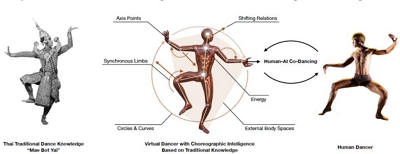
Multimodal generative Artificial Intelligence is an omnipresent technology in our post-industrial societies, as it has penetrated all areas of daily life, from social and commercial relations to the various fields of science and industry, communication, leisure and culture in general. This is to discuss whether AI is applicable to the field of artistic creation in general and to bodily arts such as dance in particular, taking into account emotional sensitivity and creativity, factors that are difficult to generate by a machine. In this article we will discuss examples of corporal artistic manifestations, in the domain of dance, in which corporality itself is called into question in the face of these interactions with humanized bodies conceived, created and “brought to life” by the magic of generative AI. The learning models developed by different Artificial Intelligence software allow these bodies to dance, model or evolve in scenographic spaces created ad hoc and shared to the point of replacing real dancers.

  • 1,109 View
  • 16 Download
Interculturalities in the Digital Age
Alexander Frame
EPISTÉMÈ 2025;33:1.   Published online March 31, 2025
DOI: https://doi.org/10.38119/cacs.2025.33.1

The digital age, with its ubiquitous social media, has transformed sociability and socialization, creating opportunities for accessing diverse knowledge, but also new symbolic boundaries. In a connected society shaped by identity politics, this article proposes an intercultural reading of social tensions relayed online. It advocates an interpretive approach to intercultural communication, understanding cultures and identities as resources individuals use to negotiate and co-construct meaning in interactions. Based on examples of social tensions relayed or seemingly aggravated by digital media, it distinguishes two forms of interculturality in this context: "forced otherness," where individuals are reduced to stigmatized identities, and "unconscious otherness," where algorithmic personalisation is used by individuals to support particular worldviews on given topics. The article draws on theories of conflict mediation, identity, and intergroup relations to analyse and potentially mitigate social tensions in the digital age, emphasizing the need for media literacy and a nuanced understanding of intercultural dynamics.

  • 866 View
  • 31 Download
A New Genre of Online Memes: A Semiotic Analysis of the Harry Potter-Balenciaga Meme
Haram Park
EPISTÉMÈ 2024;31:169-194.   Published online September 30, 2024
DOI: https://doi.org/10.38119/cacs.2024.31.9
This study analyzed the Harry Potter-Balenciaga meme to explore the impact of new memes generated by Generative Al technology on online meme culture. The concept of memes, introduced by Richard Dawkins in ''The Selfish Gene” as units of cultural information, has evolved into contemporary internet memes, becoming a significant element of online culture. The Harry Potter-Balenciaga video, created using Al technology in 2023, garnered significant attention as an innovative online meme, demonstrating an epistemological expansion in the realm of online memes. It transcended the limitations of traditional meme creation by realizing abstract ideas, leading to the emergence of a new meme genre, the 'Idea Meme.' This study captured this phenomenon by considering the Harry Potter-Balenciaga meme as a new genre. It discussed the meme as an Idea-Realizing Meme, based on Shifman's (2016) traditional meme classification, through semiotic analysis of the images and text. By analyzing the three dimensions(content, form, and stance) of the Harry Potter- Balenciaga meme from a semiotic perspective, the study explained how AI-generated memes overcome the limitations of traditional memes and expand communicative and epistemological possibilities. This research aimed to shed light on the impact of the fusion of Al technology and online digital culture on cultural life and contribute to digital culture studies and online communication research.

Citations

Citations to this article as recorded by  
  • De la pasarela al meme
    Susana Golf Sanchez, Ana Belén Bastidas Manzano, María Alcolea Parra
    SOCIAL REVIEW. International Social Sciences Review / Revista Internacional de Ciencias Sociales.2025; 13(2): 133.     CrossRef
  • 518 View
  • 4 Download
  • 1 Crossref
The Aesthetics of Daily Spoken Language of Turkish
Züleyha Hande Akata
EPISTÉMÈ 2024;31:109-132.   Published online September 30, 2024
DOI: https://doi.org/10.38119/cacs.2024.31.6
Aesthetics has been the subject of different fields from the past to the present and has been evaluated through various approaches. There are different definitions of aesthetics, but the common aspect is its association with beauty and the senses. Despite its close relationship with fields such as philosophy and art history, everyday aesthetics has developed in a different direction from these fields today, focusing on the ordinary aspects of daily life. Everyday aesthetics reveals the aesthetic value of ordinary and commonplace phenomena. Daily spoken language is such a phenomenon. Before the emergence of everyday aesthetics, studies on aesthetics mostly focused on the literary aspects of language. For example, Turkish is one of the languages in which such studies exist. There are many studies aimed at revealing the aesthetic value of Turkish, whose earliest written products we have started to see since the 7th century. The main focus of these studies is on written language and literary works thought to reflect the aesthetic value of written language. Other studies on the aesthetic dimension of language have also concentrated on written language. However, the daily spoken language of Turkish has not been included in these aesthetic studies. One of the areas where the real richness of Turkish discourse and its aesthetic value are revealed is spoken language. This study aims to provide an opportunity to make inferences about the aesthetic value of the daily spoken language of Türkiye Turkish through the concept of everyday aesthetics. The sample of the study has consisted of the most frequently used formulaic expressions in daily language. The spoken language has been analyzed in terms of everyday aesthetics by considering the functions of these formulaic expressions. While analyzing the formulaic expressions, the evaluation criteria of everyday aesthetics have been taken into consideration, and efforts were made to reveal their aesthetic value based on their alignment with these criteria and their functions in daily life. This study highlights that aesthetics extends beyond the formal and literary domains of language. It illustrates that everyday language usage can also be associated with sub-fields of aesthetics based on various criteria, in addition to the more traditional areas such as formal and literary language. The primary objective of this study is to uncover the aesthetic value inherent in the Turkish spoken language, addressing a gap in this area, and to introduce the concept of everyday aesthetics to the Turkish academic literature within the realm of linguistic performance.
  • 346 View
  • 3 Download
Children's drawings are one of the most important productive actions that enable the child to establish relationships with his environment and the outside world. Each picture drawn contains a piece of the child himself. Because he tries to express his inner world, his way of thinking, his relationship with his environment, and any problems he has; through his paintings. Therefore, due to their iconic qualities, they have a semiotic function and enable the child to be recognized and understood by those around him. As a means of communication or a sign that mediates communication, children's drawings also have aesthetic properties. Aesthetic appreciation in children's drawings transcends traditional norms. It's not about technical proficiency but about the purity of expression. A child's artwork often exudes a raw authenticity, unburdened by societal conventions, which resonates deeply with viewers. In this study, we would like to consider the importance of drawing, which is one of the semiotic function areas of communication in children, the aesthetic aspects of drawings, and how children communicate through drawing.
  • 411 View
  • 6 Download
TOP