Abstract
This study analyzed The Curious Case of Benjamin Button by integrating corporeal narratology with Greimas’s semiotic square, examining how temporality and identity are constructed and deconstructed through the body. Benjamin’s body serves as a semiotic field where oppositions like “youth/old age” and “life/death” are generated, clash, and collapse. The semiotic square revealed how these binary structures become unsustainable and the internal disintegration of the semiotic system, highlighting both the model's utility and limitations in complex corporeal narratives. Corporeal narratology emphasized the body's role as an active agent that embodies and enacts the collapse of meaning, contributing to the disintegration of narrative structure. Ultimately, the analysis demonstrated that body, time, and identity are core semiotic forces that uphold and undo narrative structures.
-
Keywords: semiotics, corporeal narratology, Greimas, semiotic square, time, identity; body, Benjamin Button
1. Introduction
Cinema is a powerful medium that renders abstract concepts such as time, existence, and identity into tangible, sensory experience. Among such works, The Curious Case of Benjamin Button (2008) challenges the binary structure of life and death, youth and old age, through its central premise: a man who is born old and dies young. This film does not merely depict a narrative of temporal reversal. Rather, it can be read as an experimental narrative that explores how the flow of time and the opposition of meanings are constructed-and ultimately dismantled-through the body.
This paper analyzes Benjamin Button from the perspective of corporeal narratology, a theory that regards the character’s body not as a mere symbol or background element, but as the structural core of narrative development and a site of meaning-making. Benjamin’s body functions as the very plot that structures his life, and serves as a seme-a unit of meaning-through which oppositional pairs such as youth and old age, life and death, operate semiotically. Furthermore, this paper employs Greimas’s semiotic square as an analytical tool to examine how these binary structures are formed and dismantled within the narrative of reverse aging. Ultimately, the analysis aims to reveal how Benjamin’s body problematizes and disrupts conventional frameworks of temporality and identity.
2. Theoretical Framework
2.1. Corporeal Narratology
Corporeal narratology is based on the premise that the body is not merely a character’s external attribute or narrative backdrop, but a central semiotic field through which narrative structure is formed and meaning is generated. The concept was formally introduced by
Punday (2003), where he argues that “the body itself constitutes the plot.” In other words, the body is not a passive object external to the narrative but a structural medium through which temporality and identity are organized.
Brooks (1993), in
Body Work, similarly conceptualizes the body as a “semiotic condensation of desire, meaning, and tension.” He focuses on the ways in which the body is symbolized within narrative and how it leads readers to interpretation and identification. In his view, the body is not a mere form within narrative but a semiotic agent central to narrative tension and identity.
Expanding upon this tradition,
Wan (2019) integrates corporeal narratology with rhetorical narratology, positing that the body is not merely a narrative instrument but a persuasive resource that elicits emotional responses from readers and viewers. She emphasizes that the body’s movements, regressions, and transformations within narrative actively reshape the interpretive process itself. This insight aligns with the present study’s reading of Benjamin Button, in which Benjamin’s bodily transformation invites viewers to reconsider notions of temporality and identity.
Although
Bordo (1993) does not use the term “corporeal narratology” explicitly, her interpretation of the body as a repository of cultural ideology and a site of resistance resonates with this line of thought. Bordo examines how female, diseased, and disciplined bodies are formed and interpreted within social and semiotic systems. Building on this perspective, the present paper understands Benjamin’s body as a semiotic site that reveals cultural “abnormality,” defying normative expectations of time and development.
Thus, corporeal narratology functions less as a fixed theoretical framework and more as a conceptual approach that explains how meaning structures in narrative are organized and reconfigured through the body. In Benjamin Button, the protagonist’s body is not only the vehicle of the plot but also the structural locus where semantic oppositions operate, shift, and eventually rupture.
2.2 Greimas’s Semiotic Square
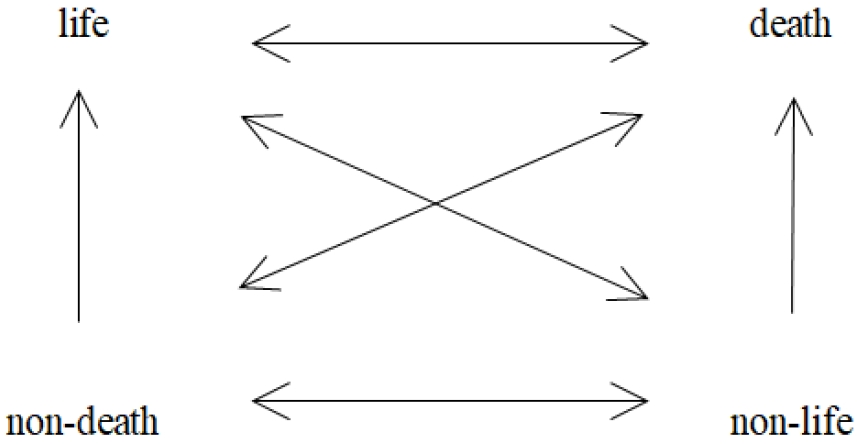
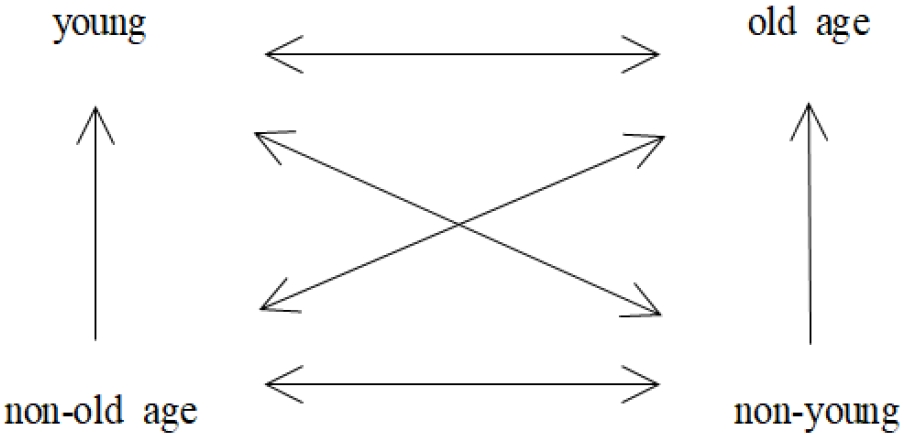
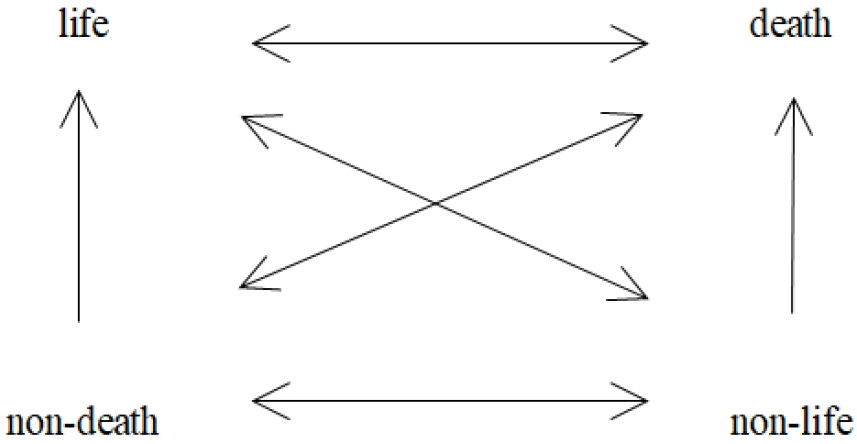
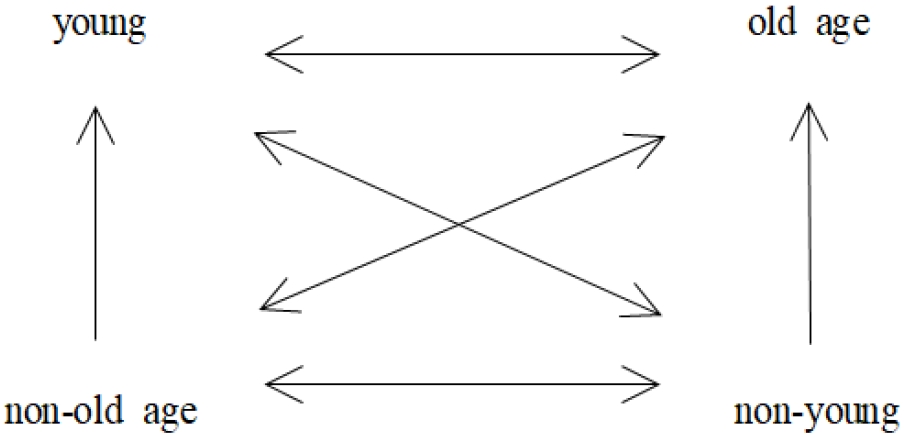
Greimas’s semiotic square provides a logical structure for mapping semantic oppositions through four positions: A, B, ¬A (the contradiction of A), and ¬B (the contradiction of B). Based on Saussurean binary opposition, this model visualizes how a single semantic unit interacts with its opposite (¬A), its opposing term (B), and the negation of that opposing term (¬B). It is especially useful for clarifying the underlying ideological or symbolic oppositions that structure extended narratives.
Kim (2002) argues that Greimas’s concept of the semethe minimal unit of meaning-is “a meta-linguistic construct that functions as the smallest element of semantic operation.” Through this concept, he argues, one can systematically analyze how meanings in narrative are structured and contrasted. The semiotic square, in this context, functions as a highly effective tool for uncovering deep narrative structures, allowing readers to intuitively grasp ideological oppositions embedded in the story.
Greimasian semiotics is particularly well-suited for analyzing ontological oppositions such as life/death and youth/old age within narrative discourse. In
The Curious Case of Benjamin Button, these semantic poles are visualized through the protagonist’s body, which embodies the tension, inversion, and eventual dissolution of these meaning structures. This paper applies Greimas’s semiotic square to examine how the binary oppositions of youth and old age, life and death, are constructed and deconstructed within the reverse-aging narrative of Benjamin Button.
Through Greimas’s semiotic square, the binary oppositions within the film can be revealed in a more structured and systematic manner. Figure 1 illustrates the opposition constructed around “life/death,” while Figure 2 visualizes the structure centered on “youth/old age.” These four positions-A, B, -A, and -B-do not simply reflect polar oppositions, but form a complex system of meaning that incorporates both contraries and contradictions. For example, “life” is in opposition to “non-life,” just as “death” is in opposition to “non-death.” Through Greimas’s semiotic square model, these four terms interact in a tense relational structure that shifts along the narrative flow.
In The Curious Case of Benjamin Button, this semiotic configuration is dynamically embodied through the protagonist’s physical transformation. Benjamin is born with the appearance of an old man and progressively becomes younger-a temporal trajectory that defies the conventional flow of time and the standard life cycle. His body moves visually from “old age” to “youth,” but within the narrative arc, he still progresses from “life” to “death.” This coexistence of “youth” and “death” in a single body marks the moment when the established semiotic structure breaks down, and binary oppositions collide from within.
Moreover, Benjamin’s body does not merely reverse the binary logic. It actively destabilizes the interdependence and presumed fixity of these oppositional meanings within the narrative. Cultural assumptions such as “youth = beginning” and “old age = end” are dismantled through the reverse-aging process, shaking the very foundation of the semiotic order that underlies meaning-making.
3.1 Childhood: A Child Born in the Body of an Old Man
The Curious Case of Benjamin Button opens with one of the most powerful illustrations of the central claim of corporeal narratology: that the body tells the story. Benjamin is born with the outward appearance of an old man; his body visually symbolizes “old age,” yet he possesses the cognition and emotion of a newborn. This discrepancy between bodily appearance and function is not a mere narrative device, but rather signals an early rupture within the semiotic system that underlies the binary opposition of “youth” and “old age.”
During this period, Benjamin lives in a nursing home among other elderly residents, but he does not occupy the same semiotic position as they do. The fact that the other residents do not reject or treat him as abnormal, but rather accept him naturally, reveals that the signifier “old age” operates only on a visual level-it has not yet been stabilized as a fully functioning sign within the system of meaning.
At this stage, Benjamin corresponds to what Greimas’s semiotic square identifies as a sign of contradiction-a sign that belongs neither fully to a semantic term (A) nor its negation (¬A), thereby generating logical tension within the system. His body is neither definitively “old” nor “non-old,” and neither “young” nor “non-young.” Instead, it occupies a liminal position at the boundaries of the semiotic system.
This type of body destabilizes the very premise of binary opposition, beginning the internal unraveling of the logical structure that the semiotic square presupposes. Benjamin’s body functions as a semiotic medium that embodies the contradiction at the heart of the youth/old age binary.
Furthermore, at this stage, Benjamin himself does not yet recognize that he is “different,” suggesting that the conditions for interpretation-the prerequisites for semiotic function-have not yet been met. Until his encounter with the Other, Daisy, his body remains unmarked by any definitive binary opposition of “youth” or “old age.” In other words, his body exists outside the structural grid of the semiotic system-as an unclassified body, or a body not yet semiotized. This condition exemplifies a core insight of corporeal narratology: the body does not inherently signify, but becomes meaningful only in relation to who interprets it, when, and in what context.
3.2 Adulthood: A Momentary Convergence of Youth and Old Age
In Benjamin’s life, adulthood marks the only period during which his physical appearance, internal self, and social relationships momentarily align in harmony. During this time, he works as a sailor, functioning effectively within society thanks to his healthy body and clear cognition. Through his romantic relationship with Daisy, he briefly experiences a semblance of normative life. In terms of corporeal narratology, this phase represents a moment in which the body naturally conveys meaning-where bodily signifiers, identity, and social functionality coincide.
Yet this alignment is only temporary. What appears to be the convergence of binary semantic positions-youth and old age-is, in fact, a momentary suspension of tension, a provisional stitching together of opposites. Benjamin’s youthful appearance and mature psychology may place him visibly within the semiotic position of “youth,” but this masks the deeper truth of his condition: he is a being who inhabits a reversed temporal structure. For him, “youth” does not signify a beginning, but rather a midpoint on a trajectory toward decline. It is not the peak of life, but part of an ongoing descent.
From the perspective of Greimas’s semiotic square, Benjamin may appear to occupy the term A-“youth”-during this period. However, his existence still harbors a dissonant temporality that cannot be fully incorporated into the logical opposition between youth and old age. Even in the moment when binary oppositions seem resolved, the semiotic structure is already poised for collapse from within.
This semiotic instability is particularly evident in Benjamin’s relationship with Daisy. Though the two share a similar age in appearance and mentality at this point, their physical timelines move in opposite directions: Benjamin becomes progressively younger, while Daisy continues to age. As a result, they inevitably move toward diverging positions within the semiotic structure, crossing paths only temporarily. Their relationship thus enacts the narrative inevitability that the provisional suturing of oppositional meanings must eventually unravel-a logic that the semiotic square both visualizes and problematizes.
3.3 Aging in Reverse: The Reversal and Collapse of the Semiotic System
From the point at which Benjamin’s body becomes increasingly youthful, a complete disjunction emerges between physical appearance, cognition, and temporal progression. Although his outward form increasingly exemplifies the cultural attributes of “youth,” internally his memory and emotional capacities regress, and his once-developed self gradually disintegrates. This disconnect between signifier and signified is a prototypical instance of semiotic breakdown from within the system.
During this phase, Benjamin can no longer participate in consistent meaning-making within social relationships. The semiotic term “youth” ceases to provide a stable category to which his body belongs. From the perspective of corporeal narratology, his body no longer serves as the subject that carries the narrative forward; instead, it becomes a medium that exposes and enacts the narrative’s internal tension and disintegration.
Analyzed through the framework of Greimas’s semiotic square, Benjamin’s body still appears to belong to the category of “youth.” However, it simultaneously undermines the semantic structure that “youth” traditionally presupposes-namely, youth as origin, vitality, and potential. In this moment, the sign “youth” no longer signifies its conventional meaning. It is reduced to an empty form, illustrating the semiotic structure’s inherent limitation: a sign loses its meaning when it becomes severed from its relational oppositions.
Benjamin at this stage retains the outer shell of “youth,” but without any operative signification within it. He becomes a signifier devoid of a signified, and his body, far from generating meaning, instead an empty frame of meaning that reveals the limits of meaning itself.
This semiotic collapse is most vividly illustrated in his relationship with Daisy. The two no longer share a common temporal experience, and Benjamin voluntarily withdraws from the relationship. This is not merely an emotional distancing but rather a dissolution of the shared semiotic identity structure they once occupied. The body, in this context, is no longer just a vehicle that reflects narrative breakdown-it performs the breakdown. It ceases to show meaning and instead enacts the failure of meaning.
3.4 Infancy: The Convergence of Youth and Death
In the final stage of the film, Benjamin appears as an infant while gradually losing his cognitive abilities and sensory perception, ultimately dying in a state of complete regression. Visually, his body embodies the extreme of the sign “youth,” yet it is simultaneously a body moving inexorably toward death rather than life. From the perspective of corporeal narratology, this moment marks the point at which the body ceases to serve as a subject that conveys or constructs meaning, becoming instead a medium that performs the end of meaning.
This stage represents the terminal point of internal collapse within the semiotic system. While Benjamin’s body appears to belong to the semiotic category of “youth,” it no longer generates the associated meaning operations such as “youth = beginning” or “youth = vitality.” At this moment, Benjamin becomes a signifier without a signified-a sign that exists without producing meaning.
From the perspective of Greimas’s semiotic square, this scene reveals the complete breakdown of logical opposition. The semantic pairs “life/death” and “youth/old age” no longer function as distinct categories; instead, they coexist and collapse within a single body. The system of meaning ruptures from within, exposing its self-contradictory limits.
Notably, Benjamin at this stage is no longer interpretable by others. He has lost the ability to speak and interact, and as such, can no longer be read or positioned as a subject within the semiotic system. He becomes a body expelled from the field of meaning, existing outside the boundaries of semiotic structure.
Ultimately, in this final stage, Benjamin’s body becomes the site where the opposing signs “youth” and “death” collide. It is no longer a body that mediates between them but one in which the very logic of opposition becomes untenable. This is not merely the narrative’s tragic ending but the semiotic unraveling of the narrative itself. If the body once upheld the narrative structure, this scene marks the moment when the body disintegrates-and the narrative disintegrates with it.
4. Discussion
This study has examined The Curious Case of Benjamin Button as a narrative in which semiotic oppositions are constructed and dismantled through the concrete medium of the body. Cinema itself is presented as a powerful medium capable of rendering abstract concepts like time, existence, and identity into tangible experiences. In particular, this film challenges the binary structure of life/death and youth/old age by presenting a protagonist who ages in reverse. It is not merely a depiction of temporal reversal but an experimental narrative exploring how time and meaning are constructed and ultimately dismantled through the body.
Greimas's semiotic square is indeed a useful analytical tool for visualizing and structuring logical relationships between semantic terms. It helps in mapping the four positions (A, B, ¬A, ¬B) and clarifying underlying ideological or symbolic oppositions structuring a narrative. However, as demonstrated by this film’s radical reversal of temporality and identity, the application of such a model reveals its own limits-the very structure designed to order meaning begins to unravel within a disrupted narrative when confronted with the protagonist's unique corporeality.
In particular, binary oppositions such as youth/old age and life/death no longer function as fixed semantic categories when mediated through Benjamin’s body. The semiotic square, while useful for visualizing these pairs, presupposes a certain stability and logical relationship between terms. Benjamin's body, existing outside this conventional structure, challenges this. His body initially embodies a contradiction, visually representing "old age" while functionally being a newborn. This discrepancy signals an early rupture in the semiotic system. During his "childhood" in the nursing home, the signifier "old age" operates only visually and is not yet a stabilized sign. He occupies a liminal position, corresponding to a sign of contradiction that destabilizes the binary premise. Even in adulthood, when his physical appearance and psychology momentarily align, this represents only a provisional suspension of tension. His "youth" doesn't signify a beginning but a midpoint toward decline, showing how the structure is already poised for collapse. As he ages in reverse, a complete disjunction emerges between appearance and function. The semiotic term "youth" ceases to provide a stable category. From the perspective of the semiotic square, his body appears to belong to "youth" but undermines its presupposed meanings (origin, vitality, potential). The sign "youth" becomes an empty form, a signifier devoid of a signified, illustrating the semiotic structure's inherent limitation when severed from its relational oppositions. Ultimately, in infancy, his body represents the extreme of "youth" visually but moves toward death. This stage is the terminal point of internal collapse, where "life" and "death," "youth" and "old age" coexist and collapse within a single body. These terms lose their mutual presuppositions and collapse into instability and contradiction. This case exemplifies how the logic of meaning production assumed by the semiotic square can become untenable in certain narrative and corporeal representations.
These structural limitations of the semiotic square, however, can be addressed through integration with the theory of corporeal narratology. Corporeal narratology is based on the premise that the body is not merely an external attribute or narrative backdrop, but a central semiotic field through which narrative structure is formed and meaning is generated. It views the body not as a passive surface that reflects meaning, but as a dynamic field that shapes and destabilizes the very structure of signification. The body is the structural core of narrative development and a site of meaning-making. Brooks conceptualizes it as a "semiotic condensation of desire, meaning, and tension," a semiotic agent central to narrative tension and identity. Wan integrates this view with rhetorical narratology, seeing the body as a persuasive resource whose transformations actively reshape the interpretive process. Bordo's perspective, viewing the body as a repository of cultural ideology and a site of resistance, also resonates, helping understand Benjamin's body as a semiotic site that reveals cultural "abnormality." In this paper, the body has been analyzed not merely as a vessel that signifies, but as a site that reveals and performs the internal tensions of the semiotic system. Benjamin's body, as the very plot and the structural locus where semantic oppositions operate and rupture, actively participates in this process. It is refigured as a subject that challenges and subverts semiotic logic, an active agent in constructing and subverting narrative meaning. His body doesn't just bear signs; it embodies semantic oppositions and enacts their collapse, thus participating in the disintegration of narrative structure itself. During his reverse aging, his body becomes a medium that exposes and enacts the narrative's internal tension and disintegration. In his final stage, it is a medium that performs the end of meaning, performing the breakdown and enacting the failure of meaning.
This analysis thus expands the theoretical applicability of semiotic theory. The semiotic square is not merely a logical diagram but a model that, when applied to narrative, must also account for its own limitations and points of rupture. This study proposes a renewed approach to the productive potential of the body as sign, through a synthesis of semiotics and narratology, demonstrating how corporeal analysis can enrich structuralist approaches.
5. Conclusion
This study analyzed The Curious Case of Benjamin Button by integrating corporeal narratology with Greimas’s semiotic square, examining how temporality and identity are both constructed and deconstructed through the body. Benjamin’s body is not merely a narrative backdrop, but the structural core of narrative development and a site of meaning-making, a semiotic field where oppositions are generated, clash, and ultimately collapse.
The semiotic square enabled a diagrammatic analysis of how binary oppositions such as “youth/old age” and “life/death” are formed. However, its application to Benjamin's reverse-aging narrative revealed how these structures become unsustainable within the narrative’s reversed temporality. The initial discrepancy between his body's visual "old age" and newborn function signaled an early rupture. His existence as a contradictory sign in childhood destabilized the binary premise presupposed by the square. Even the momentary alignment in adulthood was a provisional suspension of tension, with the semiotic structure already poised for internal collapse. The analysis showed how, as he aged in reverse, his body caused the sign "youth" to lose its conventional meaning and become an empty form. In the final stage, the coexistence and collapse of "youth" and "death" within his body marked the complete breakdown of logical opposition. In particular, the collapse of presuppositional relationships between semantic terms revealed the internal disintegration of the semiotic structure itself. This not only demonstrated the theoretical utility of Greimas’s model in mapping potential meaning structures, but also highlighted its limitations when applied to complex corporeal narratives.
Simultaneously, the framework of corporeal narratology helped establish that Benjamin’s body does not simply bear signs but functions as an active agent in constructing and subverting narrative meaning. Corporeal narratology considers the body a central semiotic field where meaning is generated and narrative structure is formed. Benjamin's body acts as the structural locus where semantic oppositions operate, shift, and rupture. It is a dynamic field that shapes and destabilizes signification, a subject that challenges and subverts semiotic logic. His body both embodies semantic oppositions and enacts their collapse, thereby participating in the disintegration of narrative structure itself. The analysis showed how his body became a medium that exposed and enacted the narrative's tension and disintegration during reverse aging, ultimately performing the end of meaning in infancy. His body wasn't merely a reflection of narrative breakdown; it performed the breakdown and enacted the failure of meaning.
Through this analysis, the study aimed to show that concepts such as body, time, and identity are not mere narrative background elements, but core semiotic forces that uphold and undo narrative structures. Benjamin’s body, by its very nature and temporal trajectory, actively engages in this process of structural formation and disintegration. Future research could extend this line of inquiry by comparing the semiotic operations and breakdowns associated with different types of bodies and more complex semantic contexts. For instance, analyzing narratives involving disabled bodies, culturally marked bodies, or bodies undergoing extreme transformations could provide further insights into how corporeality interacts with and challenges semiotic systems and narrative structures. In doing so, a broader understanding of how meaning is produced through the interaction of corporeality and narrative structure may be achieved, offering new avenues for analyzing narrative meaning-making beyond traditional structuralist or purely literary approaches.
<figure 1>
<figure 2>
REFERENCES
- Bordo, Susan. (1993). Unbearable weight: Feminism, Western culture, and the body. University of California Press.
- Brooks, Peter. (1993). Body work: Objects of desire in modern narrative. Harvard University Press.
- Kim, Sung-do. (2002). From structure to sensibility. Korea University Press.
- Punday, Daniel. (2003). Narrative bodies: Toward a corporeal narratology. Palgrave Macmillan.
- Wan, Xiaomeng. (2019). Body as resource of narrative communication: An intersection of corporeal narratology with rhetorical narratology. Word and Text: A Journal of Literary Studies and Linguistics, 9144-158.