Abstract
This article analyzes Um Tae-hwa’s Concrete Utopia (2023) through Yuri Lotman’s concepts of spatial modelling, boundary, and the semiosphere, to elucidate how the sign of the apartment constitutes dread within Korean society and to submit the discourse of K-dystopia to critical scrutiny. Reading that discourse as a mode of self-description reorganized under the conditions of transnational circulation and global-platform legibility after the global success of Squid Game (2021), the study attends to the local surplus that such naming fails to carry across, declining nonetheless to consign it to the untranslatable. Two movements compose the argument. Beyond the film, the specificity of the Korean apartment is bound to the discourse of K-dystopia so as to disclose a dread that circulation leaves untranslated; within the film, scene analysis traces the visual codification of interior against exterior, the graduated nullification of the other, and the closure of the boundary through the ossification of self-description. Diegetic exclusion and discursive subsumption prove to be a single semiotic operation nested at two magnitudes, a matryoshka isomorphism in which the recurring unease articulated in Korean viewer reviews may be read as registering the homology of the two. Untranslated dread, so situated, opens onto a productive site of reappropriation and emergence.
-
Keywords: Concrete Utopia, Yuri Lotman, Semiosphere, Boundary, K-Dystopia, Apartment
1. Introduction
Um Tae-hwa’s Concrete Utopia (2023) takes Building 103 of the Hwanggung Apartment as its stage, the sole structure spared collapse in a Seoul reduced to ruin by a great earthquake. The film advances neither the spectacle of catastrophe as such nor the heroic narrative of crisis surmounted; beginning instead from a world wherein catastrophe has already arrived and hardened into the given as the condition of the post-catastrophe, the film therefrom fixes its gaze upon the bared faces of a human multitude contending for nothing but survival amid a foundered order. With the survivors beyond its walls named cockroaches and labeled as expendable nonhumanity to justify exclusion and violence as the consensus of a community, the film’s tableau departs unmistakably from the conventional grammar of the disaster film, wherein protagonists registered the premonitory signs of crisis and surmounted calamity through reconciliation and solidarity with kin and neighbor.
Criticism and journalism alike have characterized the despairing structure of feeling that recent Korean screen narratives summon as
dystopian. The question from which this study departs lies in that very act of naming. Does the dread of
Concrete Utopia issue from some bleakness of a future that the generic category of dystopia promises? Or does its epicenter lie elsewhere, in the
Concrete Utopia that the film’s title cites outright, which is to say in the Korean sign of the
apartment? Recalling that
Park Hae-cheon (2011) traced the visual culture and the form of desire proper to the Korean middle class under the title
Concrete Utopia, one may surmise that what the film in truth summons beneath its disaster-genre integument is the semiotic system of a Korean apartment culture sedimented across some six decades (
B.-R. Kim, 2023).
This study therefore brackets the generic integument of dystopia for the moment and elects to begin its inquiry from the
apartment, the cardinal sign with which the film is concerned. Within Korean society the apartment has functioned not as a mere form of dwelling but as a coordinate system of class and a de facto certificate of social membership (
Gelézeau, 2003/2007;
Jeon, 2009;
H.-C. Park, 2011), with the media soliciting this sign as an object of desire and an emblem of safety (
H.-J. Lee, 2013). The singular affect that
Concrete Utopia provokes, registered in the responses of some Korean viewers as a recurring
unease and
queasiness to be examined below, is by no means unrelated to the manner in which this local sign of the apartment operates. This article therefore takes up the semiotic mechanism of that affect through Yuri Lotman’s cultural semiotics, asking anew, and critically, what the discourse of
K-dystopia renders unseeable in the work.
A dystopian sensibility that, having excised the possibility of surmounting crisis, compels one to confront the here and now as hell itself has lately installed itself as the new dominant species of Korean screen narrative (
Cho, 2025). Where the disaster film of an earlier moment arranged its fantasies of solidarity and bond as a utopian impulse and thereby solicited an ethical sensibility and a posture of responsibility (
Han, 2019), the works of the present hour concentrate upon exposing how the individual, presupposing a community already dissolved, incorporates the capitalist order and its desires into the body. These works are absorbed at the same time in summoning the predicaments of Korean society, rendering shared a structure of feeling given over to competition, class, and inequality (
S.-W. Lee, 2021).
What warrants closer scrutiny is the readiness with which screen narratives freighted with despairing affect are gathered under expressions such as
dystopian imagination or
dystopian worldview (e.g.,
Choi, 2022), the critical charge and generic specificity that
dystopia harbors passing all but unexamined. The ambiguity of
K-dystopia as a concept, the prefix
K affixed at its head, carries the further hazard of reducing Korean society wholesale to a bleak atmosphere or a negative worldview. Texts figuring a collapsed world are parceled out under differentiated names,
dystopia, disaster, apocalypse, post-apocalypse, yet the prior studies that gather them under the broad rubric of the bad place converge upon a shared misgiving, that the heterosexual romance and familial affection which had long served as the axis of Korean narrative are being effaced in the wake of the global OTT platforms, as the apocalyptic and dystopian worldviews of Western genre fare grow ever more universal (
Baek, 2024;
D. Lee, 2025).
What demands retracing is the question of from whose vantage point, and by what means, the
Korean type is cast, a question rendered only more acute by the circumstance that the recent content treating annihilation, apocalypse, and the dystopian worldview rests heavily upon global OTT platforms. The mass influx of foreign viewers by way of those platforms furnishes a foothold for the growth of the Korean content industry, yet it is at the same time the yield of a sales strategy appropriated as an apparatus of hegemony, calibrated to solicit common interest and stimulation among global audiences (
D. Lee, 2025, p. 238). As
S. Park and Ryoo (2024, p. 149) observe, the transnational platforms led by Netflix expand the visibility of K-content even as they reproduce
Koreanness after a particular fashion, and within that very process Korean content remains passively lodged inside the magnetic field of the American culture industry.
The discursive trajectory of the term
K-dystopia is for this reason symptomatic in itself. The term began to surface as a descriptive expression in domestic journalism immediately after the global success of
Squid Game in 2021 (
Jeong, 2021), entering popular circulation in early 2022 as several press outlets reported it explicitly as a neologism (
Choi, 2022;
J.-Y. Kim & Yun, 2022;
M. Kim, 2022). Named thereafter as a term of genre criticism in a 2023 column of drama criticism (
S.-Y. Kim, 2023), it settled into scholarly language that same year, when the article of
Lim and Lee (2023, p. 79), published in the journal
Situations, deployed
K-dystopia as the name of a subgenre. Its trajectory, in sum, follows the order of success on a global platform, coinage and circulation within the domestic press in the wake of that success, and scholarly sedimentation, which suggests that the term took shape less as a naming imposed from without than as a mode of naming conditioned by transnational circulation and global-platform legibility — a self-description recast in the terms most legible to the global semiosphere. This path of formation is no matter of mere etymological curiosity, for the language of whichever semiosphere a discourse is formed within determines, in the end, what that discourse is able and unable to see. Here lies the need to mark the politics of the prefix
K. As K-pop, K-drama, and K-food alike attest, the prefix K has functioned less as a self-definition internal to Korea than as a branding device taken up at home to heighten legibility within the global market, its very naming anticipating and internalizing an external gaze (
Yoo, 2026),
K-dystopia being no exception. The moniker approximates less a critical category that Korean society devised to reflect upon its own darkened present than a category that retroactively binds a body of commercially vetted texts and packages them as an exportable genre. As
Noh (2025) shows, the K-dystopian content of Netflix is actively mobilized as an object of immersive spectacle and transmedia marketing, whereupon dystopia turns a form not of critique but of experience and consumption.
What is excised in this process of translation, namely the specificity of a dread that operates only within the local semiosphere, is the concern of this study. In the discourse of K-dystopia formed in the language of the global semiosphere, Korea’s local dread is repackaged as material for universal empathy, as survival game, zombie, and class conflict, while the grain of a dread operative only within the local semiosphere of Korea is left over as surplus. This article takes the discourse of K-dystopia as its point of departure because the conditions of that discourse’s formation structure what becomes visible and what remains obscured.
1.2 Reading at the Boundary: From the Untranslatable to the Untranslated
Here a theoretical discrimination must be drawn. To define the
surplus invoked above only intuitively is to risk sealing it as the
untranslatable, on the supposition that the dread cannot cross borders because the language of the global semiosphere can never render the specificity of the local one. Such a definition, however, appropriates Lotman’s theory of the semiosphere too narrowly, for Lotman nowhere argues the impossibility of translation. What he thinks through is rather the translation that transpires at the boundary and the emergence that issues from it, the explosion which, as the very moment of unpredictability, generates new and unforeseeable meaning (
Lotman, 1992/2009, pp. 123–125).
The boundary is no wall at which translation founders but a
bilingual filter that renders an external message into the internal language of a semiosphere, and back again, the most active point at which a semiosphere meets its outside and brings forth new meaning (
Lotman, 1990, pp. 136–137, 142; 1984/2005, p. 210). Because the structure of the semiosphere is asymmetrical, the mutual translation of its heterogeneous languages becomes a generator of information, and the incompleteness of translation is no defect but the condition under which new meaning emerges.
Departing from this sense of dissonance in the figuring of K-dystopia, this study redefines the dread that Concrete Utopia holds not as the untranslatable but as the untranslated. The naming of K-dystopia preempted and translated the film’s local dread into the lexicon of a universal genre, and within that smooth translation the local surplus was left unconveyed. Yet, the untranslated is not the untranslatable. It is rather a productive site at which reappropriation and emergence may occur. Asserting that the question is in which semiosphere’s language the surplus is to be read anew, this study proposes Lotman’s cultural semiotics as that very language.
From the foregoing problematic the study poses two research questions. First, what has the discourse of K-dystopia, by virtue of having been formed in the language of the global semiosphere, been structurally rendered unable to see (RQ1)? Second, through which visual, spatial, and linguistic codes does the local sign of the Hwanggung Apartment constitute the dread of Korean society, and how does that dread stand homologous, in isomorphism, within and without the film (RQ2)? These questions are posed so as to remain open to disconfirmation: were the dread shown to derive wholly from transferable genre convention, or were the apartment sign to prove dispensable to the affect the film produces, the reading proposed here would not hold.
The two questions are thus joined: what the discourse has proved unable to see lies within the local sign of the Hwanggung Apartment, and it is to the reading of that sign that Lotman’s semiotics of the boundary is put.
2. Theoretical Background and Review of Prior Research
2.1 A Conceptual History of Dystopia and Its Dehistoricization
Etymologically,
dystopia is a compound of the Greek
dus, bad or diseased, and
topos, place, signifying a flawed and unfavorable place, and most of what the word evokes is a modern phenomenon bound up with secular pessimism (
Claeys, 2017, p. 4).
Dystopia needs to be distinguished from its neighboring terms.
Apocalypse, deriving from the Greek for the lifting of a veil, has come in its earthly sense to denote the end of the world as we know it, the terminal event itself, while the
post-apocalypse designates the world that persists after such an event (
Skult, 2019); dystopia, by contrast, need not presuppose any catastrophe, being the critical modelling of an oppressive, unequal, or otherwise undesirable social order (
Claeys, 2017) — a social and political imagination that may unfold, as in the canonical texts adduced below, in worlds untouched by terminal collapse.
Concrete Utopia is in this respect a hybrid case, employing a post-apocalyptic setting while constructing within it a dystopian social order (cf.
Skult, 2019, p. 185), a distinction upon which the reading of its denouement in Section 4.5 will turn. A glance across the canonical texts suffices to confirm that the critical force of dystopia derives from a historical coordinate. Orwell’s
Nineteen Eighty-Four held a concrete target in Stalinism and the totalitarian apparatus of surveillance; Huxley’s
Brave New World was a warning against an industrial civilization careening toward Fordist mass production and a society of administered pleasure; and Fritz Lang’s
Metropolis translated the industrial capitalism and class division of Weimar Germany into the figure of the vertical city. What the three texts show in common is that dystopian narrative was produced in response to particular political subjects and historical contexts, its critical efficacy arising from the tension with those contexts. Dystopia is not an inventory of generic grammar but a form of utterance upon history.
The genre circulation of the global-platform era, by contrast, severs history from this form of utterance. Generic grammar such as the ruined mise-en-scène, the rules of the survival game, and the plot of class inversion travels easily across borders, yet the ideological target at which that grammar was originally aimed does not. The dehistoricization of dystopia of which this study speaks describes just such a process, in which only the form of the genre travels while the coordinate of critique falls away. The discourse of K-dystopia has succeeded in registering Korean-made texts as a coordinate upon the global genre map, yet it has failed to read the utterance that each text performs upon the historical coordinate of Korea.
This article’s account of dystopia rests upon the genre’s critical tradition rather than its circulating grammar alone.
Suvin (1979, pp. 3–15) locates the force of the estranging genres in their capacity to hold the reader’s empirical world at a cognitive distance, and
Sargent (1994) distinguishes the dystopia proper from a flat anti-utopia by the social-dreaming impulse that subtends it.
Moylan (2000, pp. 183–199) theorizes the
critical dystopia as a text that preserves, within its bleakness, a residual utopian core, a locus of hope that keeps the form open to history rather than sealing it as despair, a reading the editors of
Dark Horizons extend in insisting that dystopia be read within its histories rather than as a timeless mood (
Baccolini & Moylan, 2003, pp. 1–12).
Jameson (1991, pp. 279–296;
2005) diagnoses, conversely, a
nostalgia for the present, the tendency of late-capitalist culture to convert historical content into consumable image, and it is this conversion that the term
K-dystopia performs when it registers a text upon the global genre map while shedding the historical coordinate upon which the text speaks.
Existing research on Korean dystopian content has concentrated, for the most part, upon the narrative stratum: upon storytelling strategy (
Baek, 2023), the typologization of worldview (
D. Lee, 2025), and the conjunction of survival narrative with meritocracy (
Kang, 2022). Illuminating as these studies are of the generic character of
K-dystopia, they leave insufficiently answered the question of the semiotic mechanism through which the dread of a single text is constituted, and of why a particular dread should resist translation across borders. It is that lacuna the present analysis seeks to fill, by way of a film-semiotic approach, and above all through Lotman’s spatial semiotics as its critical lens.
To read the sign of the Hwanggung Apartment one must first examine the singular standing that the apartment occupies in Korea. Under the principle of growth first and distribution later, Korea passed through a state-led modernization in which, once the state had set a goal, government, enterprise, and populace concentrated the national strength toward its attainment. As a side effect of a compressed-growth strategy that spurred short-term external success, an ethos of performance and result-centrism rose to the foremost value of society (
Chang, 2010); the apartment is the material specimen of such compressed growth.
Gelézeau (2003/2007) calls Korea a
Republic of Apartments, showing that the large-complex apartment is a residential form peculiar to Korea brought forth by the conjunction of the authoritarian developmental state, the
chaebol, and middle-class desire. What matters here is that Gelézeau apprehended the
Korean specificity of this form through the gaze of a French geographer. The semiotic value of the Korean large-complex and brand apartment, that is, cannot simply be mapped onto apartment dwelling in other urban contexts. Within Korea the apartment has operated as an attainment goal of the middle class while signaling asset accumulation and class ascent (
Gelézeau, 2003/2007;
Jeon, 2009). The identical signifier
apartment is accorded historically divergent values across semiospheres, and it is this semiotic asymmetry that constitutes one condition of the
untranslated dread to be examined below.
The history of the Korean apartment is in itself a chronicle of compressed growth. Since the completion of the Mapo Apartment in 1962 the apartment became the standard form of state-led housing supply; it interlocked with the formation of a nascent middle class across the Gangnam development and the large-complex construction of the 1970s and 1980s (
Jeon, 2009;
H.-C. Park, 2011). From the 2000s onward, the hierarchy among complexes was refined through the brand naming of construction firms, such as Palaces, Castles, and Parks (
Chae, 2004). What the naming
Dream Palace evokes, as such, within the film is this language of brand hierarchy. The apartment in Korea, in short, is at once a residential form and a coordinate system of class, with tenancy and ownership functioning as the de facto certificate of social membership (
Gelézeau, 2003/2007;
Chae, 2004;
Jeon, 2009). That the residents of the Hwanggung Apartment restore, first of all after the disaster, not the safety of dwelling but an order of belonging voiced in the language of ownership is a cinematic statement of how deeply this coordinate system has been internalized (see 4.4).
That the apartment took its place as an object of desire for Koreans owed decisively to a repeated solicitation through the media (
H.-J. Lee, 2012,
2013). The model houses and presale advertisements of the 1970s and 1980s presented the apartment as an emblem of modern and hygienic middle-class life, and television dramas and commercials reproduced the apartment living room time and again as the stage of a harmonious household and economic stability (
H.-J. Lee, 2012). As H.-C.
Park (2011) analyzes, the apartment in this process became, beyond a mere dwelling space, a
form of the image that cast the visual culture of the Korean middle class. The sign of the apartment, that is, has been imprinted upon the desiring structure of Koreans, in advance of any material substance of concrete, as an image of
safety and
success that the media ceaselessly produced and circulated. The
utopia that the title of
Concrete Utopia evokes is this concrete dream that the media had promised, and the film exposes the underside of the sign by colliding the image of that dream against the contrary mise-en-scène of ruin. Here lies the reason for beginning from the sign of the
apartment in advance of the generic frame of
dystopia. The dread of this film arises not from the conventions of any genre but from the sign that the media molded across six decades into an object of desire, now baring its face upon the ruins.
2.3.1 Spatial Modelling, the Semiosphere, and the Duality of the Boundary
For Lotman the world-picture of a culture, its
kartina mira, is necessarily spatial. A culture grasps order through spatial relation, expressing even non-spatial oppositions of value, the organized against the unorganized, culture against chaos, in a
topological-spatial language (
Lotman, 2000/2008, p. 18). Spatial properties such as inside and outside, high and low, open and closed are at once the outward form of a cultural model and the bearer of its axiological hierarchies.
A model, on this account, is not a replication but a selective analogy, a reconstruction of certain facets of its object rather than the whole, so that one text may at once depict a single life and model life as such, and the spatial structure of the text comes to model the structure of the world (
Lotman, 1977, pp. 211, 216–217). The basic unit of plot is in turn the crossing of a
topological boundary whose defining property is its impenetrability, and the right to cross belongs to the mobile character alone, the immobile being those whom the classification holds fast (
Lotman, 1977, pp. 229–231, 238). It is as this
mobile character that
Myeong-hwa is read below.
What such a boundary partitions, at the scale of culture, is the
semiosphere which Lotman frames by analogy with Vernadsky’s
biosphere: the semiotic space outside which no act of meaning can take place, a whole that precedes and conditions every particular language (
Lotman, 1984/2005, p. 208). Its most basic operation is the drawing of a
boundary. Every culture organizes itself by dividing an internal
our space, ordered and safe, from an external
their space figured as hostile and chaotic, so that inclusion and exclusion become the elementary principle of culture as such (
Lotman, 1990, p. 131).
The boundary, however, is double, for it at once separates the two spaces and joins them. It is the
filter through which an external text is rendered into the internal language, and the incompleteness of that translation is the very condition under which new meaning arises (
Lotman, 1990, pp. 136–137, 142). Meaning is generated most intensely not at the center of a system but along this peripheral seam. A semiosphere develops, further, a meta-level of
self-description at which it codifies its own grammar and laws (
Lotman & Uspensky, 1978); the difficulty, decisive for the reading of the
Hwanggung Apartment Residents’ Code below, is that the more rigidly a system describes itself, the more it forfeits the capacity to translate with the outside, and hardens (
Lotman, 1984/2005, pp. 211–212).
2.3.2 Asymmetry, Emergence, and the Isomorphism of Scales
The semiosphere is, crucially,
asymmetrical. An isolated, static system is impossible, and it is the asymmetry among its heterogeneous languages that turns their mutual translation into a generator of information (
Lotman, 1984/2005, pp. 219–220). This asymmetry is sharpest between
center and
periphery. As the center reinforces its self-description, the periphery comes to feel the center’s norm as
the grammar of a foreign tongue, and a stratum of peripheral phenomena is treated, from the center’s vantage, as
though non-existent and so wholly
excluded, the space beyond figured as mere chaos (
Lotman, 1990, p. 134).
S. H. Kim (2008, pp. 504–506) aligns this nullification with Foucault’s marginalization and with Giorgio Agamben’s
homo sacer, the inclusive exclusion of one who dwells within the system yet counts as not existing. This logic of nullification governs the reading of the naming
cockroach below.
Yet the periphery is also the site of semiotic dynamism, and here the reading turns. The very condition in which the center’s language is felt as foreign is what allows new languages to arise at the edge, where metaphorical translation pumps in both directions and texts are generated in profusion (
Lotman, 1990, p. 142). Cultural contact is in this sense never one-sided reception but reciprocal dialogue, and the boundary is not the dead end of translation but the inception of emergence. Such translation always leaves a
surplus, for the image a culture forms of its other sacrifices the features most valuable in the original (
Lotman, 2000/2008, pp. 289–290); the boundary figure must therefore be at once domesticated and left foreign, the contradictory
pogany, the
our pagan, translated into the internal language while remaining untranslated (
Lotman, 1990, p. 137). This surplus is not a failure of translation but the condition of the boundary’s productivity.
What holds at the boundary holds at every scale.
S. H. Kim (2002, pp. 238–239) draws out the
matryoshka structure implicit in Lotman’s account: the semiosphere is never singular but holds within it smaller semiospheres marked off by internal boundaries, each part a totality resembling the whole and standing to it in a relation of
isomorphism. The asymmetrical brain with its two hemispheres, the multilingual structure of the text, and the plural-language mechanism of culture share, across differences of scale, a single invariant, the coexistence of two distinct mechanisms for modelling the world (
S. H. Kim, 2002). It is this isomorphism that licenses the present reading to bind into one homologous structure the boundary-work performed within the film and the boundary-work performed by the discourse that surrounds it.
3. Analytic Frame and Method
3.1 From Untranslatability to Emergence and Homology
The analysis draws the foregoing concepts together to take them as its working language. First, from the vantage of modelling, the Hwanggung Apartment is a selective representation and a radicalized model of Korean apartment culture,
something that is A yet not A. Second, from the vantage of spatial partition, the film systematizes the opposition of interior, culture and order, and exterior, non-culture and chaos, into the visual codes of color, lighting, and composition. Third, with respect to boundary, the film narrativizes the process whereby a boundary that ought to have been the membrane of translation is degraded, through the ossification of self-description, into a wall of exclusion and at last sealed shut, so that the productivity of the semiosphere is brought to a halt (
S. H. Kim, 2008, pp. 503, 509).
A terminological caution is in order before the analysis proceeds. The global semiosphere invoked in this study does not denote world culture in its totality, nor a single homogeneous space standing over against a Korean one. It designates, for economy of exposition, the transnational discursive field formed where global streaming platforms, international criticism and festival circuits, the genre grammar of Anglophone commentary, and the international circulation of film intersect — what might more precisely be termed a platform-mediated transnational semiosphere. The opposition of global and Korean semiospheres employed below is accordingly an analytic shorthand for degrees of translatability within this field, not a claim that two discrete and internally uniform spaces confront each other.
The aim of this analysis is to disclose that the closure of the boundary which this film exhibits recurs in a relation of isomorphism across two scales, the labor by which the Hwanggung Apartment names and excludes the outsider within the diegesis, and the labor by which the global semiosphere translates and subsumes local dread into a universal genre outside the discourse, and to argue that the recognition of this homologous structure is what the unease recurring in Korean viewer reviews may be read as registering. And it is to propose that the possibility of that recognition is the site at which untranslated dread may be reappropriated in Lotman’s language and made to bring forth new meaning.
3.2 Research Object, Scene Selection, and Supplementary Material
The object of analysis in this study is Um Tae-hwa’s feature film
Concrete Utopia (2023, produced by Climax Studio and BH Entertainment). The method of analysis is film-semiotic textual analysis, performing scene-unit analysis across three strata in particular: the visual stratum of color, lighting, camera angle, framing, and composition; the spatial stratum of the disposition of apartment interior and exterior and of the courtyard as boundary space; and the linguistic stratum of acts of naming, the residents’ code, and reiterated utterance. As supplementary material the study draws upon the Naver verified-viewer reviews that evince the work’s mode of reception (
Table 1). These reviews are treated as illustrative rather than evidentiary: drawn from the most-liked verified-viewer comments containing a preselected lexicon, they form a small and self-selected sample, and thus attest the presence of an affective response rather than its distribution.
The criteria for selecting scenes follow the three strata set out above. To the visual stratum belong the opening montage, the exterior ruin scenes, the interior feast scene, and the residents’ meetings early and late; to the spatial, the standoff in the courtyard and the vote to expel the outsiders; to the linguistic, the posting of the residents’ code and the marking scene.
* To redress the arbitrariness of interpretation to which textual analysis is prone, the analysis was read against the audience review material (
Table 1) and the socio-historical scholarship on apartment culture (
Gelézeau, 2003/2007;
Jeon, 2009;
H.-C. Park, 2011), which serve as correlative rather than confirmatory evidence.
4. The Semiosphere of the Hwanggung Apartment
4.1 The Visual Codification of Spatial Partition: Culture and Non-Culture
The first semiotic labor of
Concrete Utopia is to systematize, into opposed visual codes, the interior of the Hwanggung Apartment, alone left unfallen after the great earthquake, and the exterior world reduced to ruin (
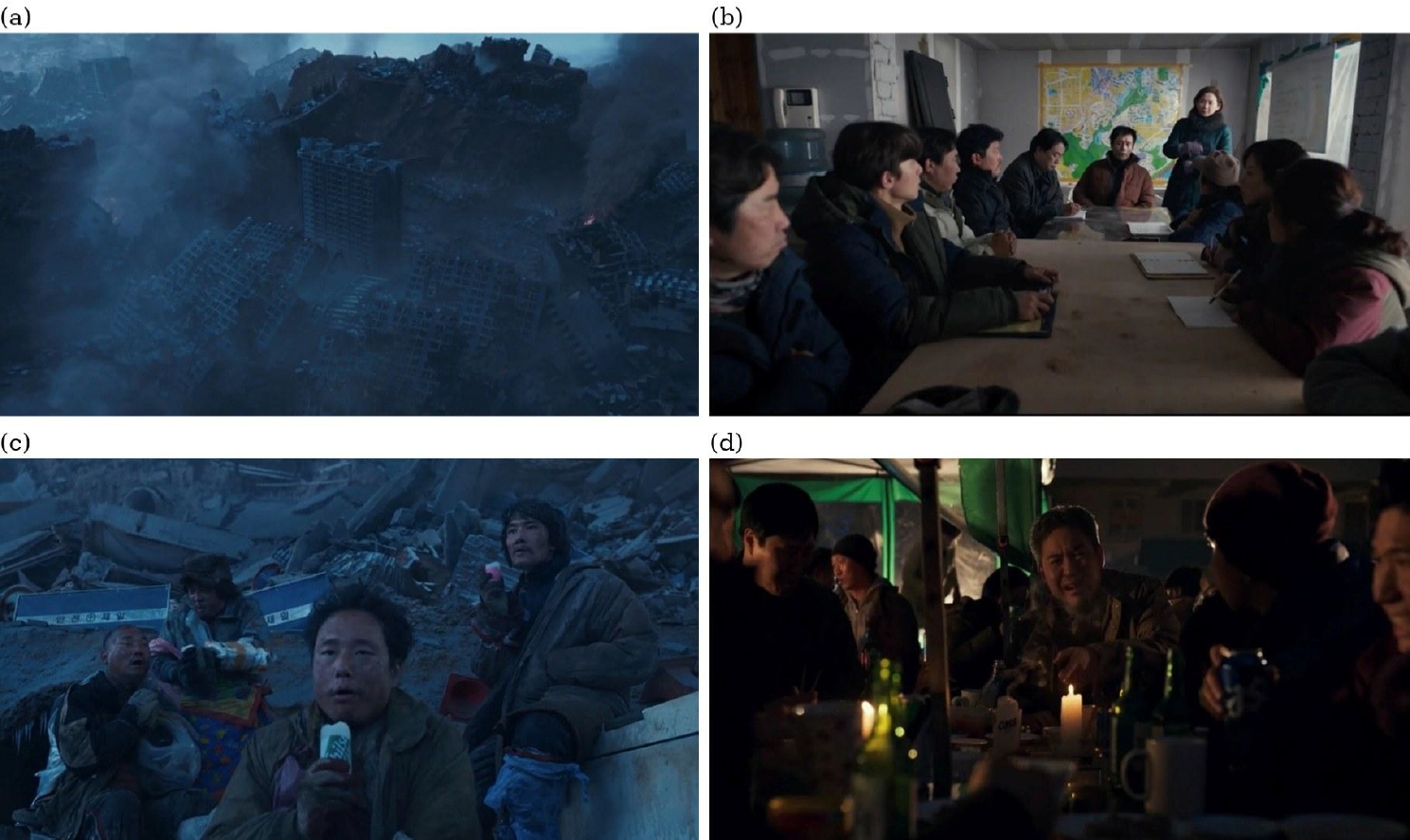
Figure 1). The exterior world is reproduced with consistency in grayscale achromaticity, billowing dust, and cold color temperature, codified as the space of non-culture and chaos (
Figure 1a). The interior of the apartment, by contrast, is filled with lighting of warm color temperature, with ordered color, and objects of order such as the dining table and the meeting table, codified as the space of culture and order (
Figure 1b). The contrast accumulates not as a mere artistic choice but as a systematic semiotic opposition. An identical act, the act of
eating for instance, is performed in the exterior upon the ruins, beneath a shroud of dust (
Figure 1c), whereas in the interior it is performed in the form of a feast set with candlelight and wine cups (
Figure 1d). If the meal of the exterior is survival, the meal of the interior is culture. Reiterating and reinforcing the opposition of interior and exterior thus across every dimension of food, clothing, and shelter, the film constructs the Hwanggung Apartment as a cultural space in the Lotmanian sense and its outside as an unsemioticized chaos. This visual codification becomes the semiotic ground that prepares in advance, for all the violence of exclusion that is to unfold, the alibi of justification that is
the safeguarding of order.
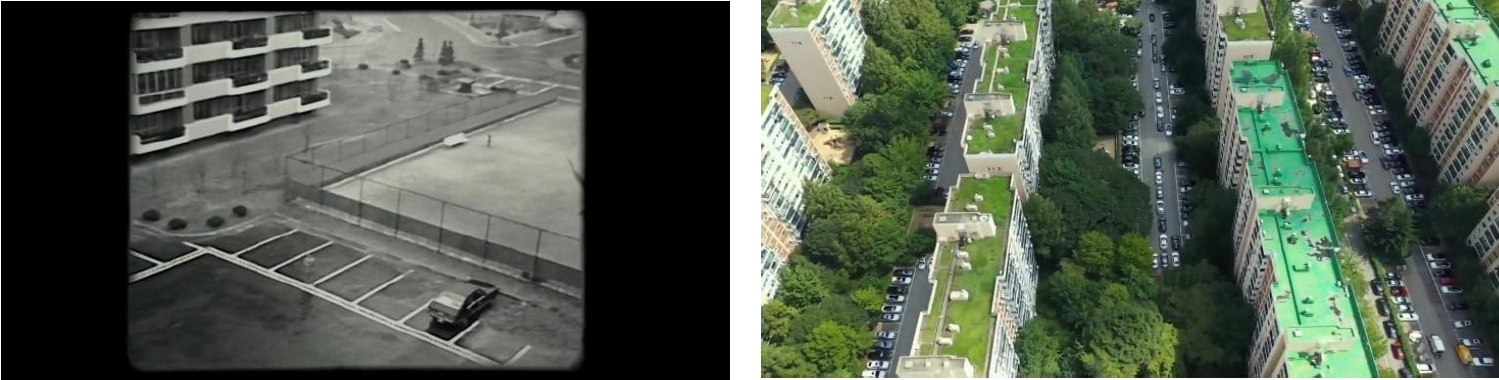
The self-referentiality of this spatial partition is declared already in the film’s opening (0:01:00–0:02:50). Before the narrative proper begins, the film presents a montage in the manner of documentary footage, compressing the history of the Korean apartment: the demolition of shanty towns, the construction of the complexes, the presale fervor, the scene of occupancy (
Figure 2). This montage is a device that specifies from the first that the object of the film’s analysis is not
this apartment but
Korean apartment culture in its entirety. In the language of modelling, the film begins by itself declaring of what it is the model. By virtue of this self-referential prologue every subsequent disaster narrative comes to be read not as a hypothetical future but as the radicalization of an accumulated past, and the narrative source of the
déjà vu that the audience reviews report is prepared here.
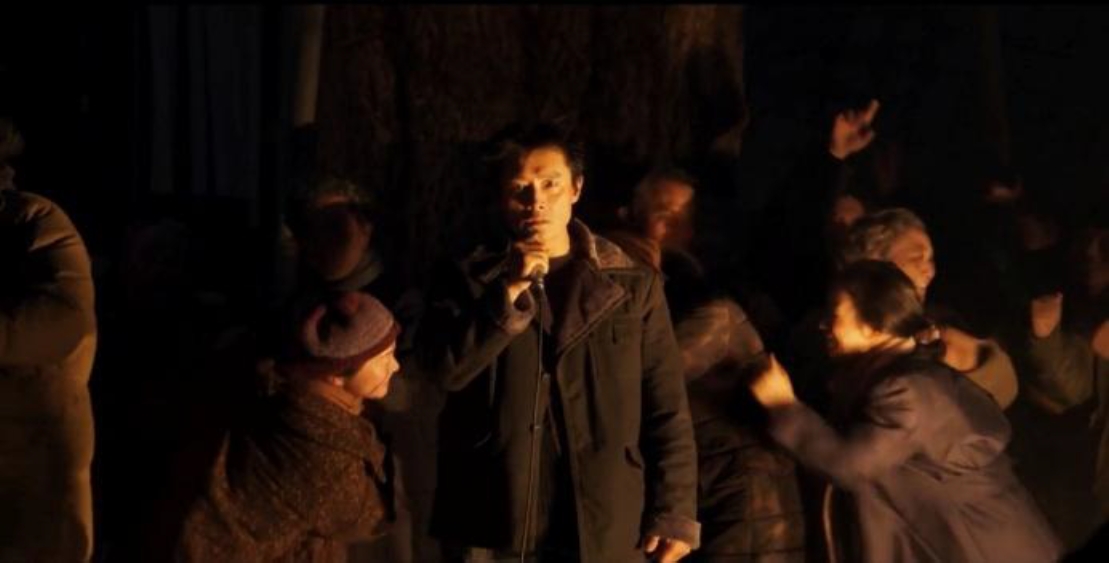
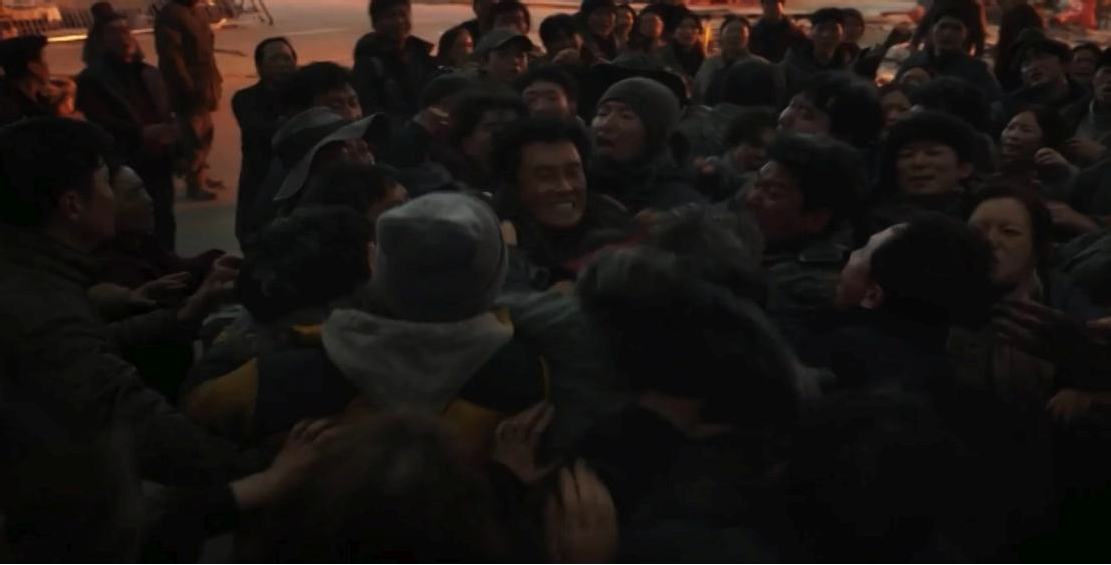
Where the contrast of interior and exterior collides most compactly is the residents’ feast scene (
Figure 3). After the violent decision of outsider expulsion, the residents gather in the courtyard, hold a feast, and sing in chorus Yun Su-il’s popular song
Apartment (1982). This song, which had borne the optimism of the apartment era of the 1980s, is recontextualized as a sign of uncanny irony by being sung in the midst of ruin and exclusion. The distance between the dream of the concrete utopia that the song had promised and the present at which that dream has arrived is made visible within a single scene. Inasmuch as this festivity is juxtaposed, further, with the death of the exterior, the feast scene performs across every stratum of the auditory and the visual the film’s cardinal proposition, that the culture of the interior is constituted only upon the exclusion of the exterior.
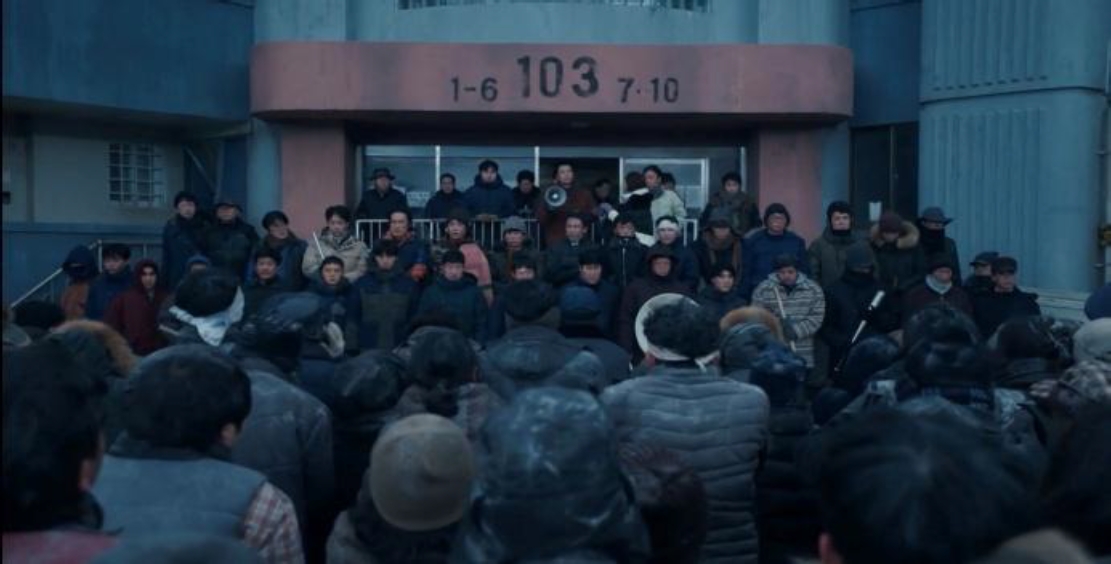
The courtyard of the Hwanggung Apartment is the most problematic space in the semiotic structure of this film. The courtyard is neither interior nor exterior to the apartment but the boundary space in which insider and outsider come face to face. Yet at the courtyard of the Hwanggung Apartment translation does not occur. When the exterior survivors gather in the courtyard, the residents range themselves with their backs to the apartment and facing the outsiders, so that by the disposition of their bodies they semioticize the opposition of culture against non-culture (
Figure 4). In the place where dialogue and negotiation ought to occur, the spatial disposition has already preempted the answer.
As the film proceeds, the semiotic character of the courtyard passes from a
place of translation to a
place of standoff and exclusion. That the vote to expel the outsiders, the rite of banishment, and the public performance of punishment all take place in the courtyard is significant. The process by which a boundary that ought to have been the membrane of translation is degraded into a wall of exclusion and violence, the process this study calls after
S. H. Kim (2008, pp. 503, 509), the
degradation of the boundary, is the tragic engine of the film, and, to follow Lotman’s proposition, its consequence is foretold. When the productivity of the boundary halts, the meaning-generation of the semiosphere halts as well. What the film shows is not that
the boundary is by nature untranslatable but the event whereby
a boundary that had been translatable is violently sealed shut.
That the courtyard is chosen as the stage upon which the rite of exclusion is performed has an architectural reason. In the corridor-type structure of the Hwanggung Apartment the courtyard is the space overlooked by the corridors and windows of every household, the space of maximal visibility. That the vote to expel the outsiders, the banishment, and the punishment of the violators of the code are all performed publicly in this space is no accident, for the efficacy of the rite depends on visibility. Exclusion performed before the eyes of all is not merely the act of driving out one person but the act of making accomplices of all who watch and of inscribing the norm of the boundary upon each of their bodies. In this respect the courtyard is at once a boundary space and a theater on which the self-description of the semiosphere is staged, and the film, by seating the cinema audience over the audience within this theater, calls forth the complicity of the act of watching.
4.3 Acts of Naming: The Graduated Dehumanization and Nullification of the Other
Spatial exclusion proceeds abreast of linguistic exclusion. In the film the naming of the outsider draws a descending curve of three stages. The first stage is those Dream Palace people. In this naming the other is still human, yet an other distinguished by class by way of the name of a brand apartment. Considering that the prior hierarchy, the older, non-brand Hwanggung beneath the brand-apartment Dream Palace, has been inverted after the disaster, this naming connotes the pleasure of a reversed retribution for past humiliation. The second stage is outsider. Here the other is abstracted from a class other into a spatial other. The criterion of naming is no longer who he was but on which side of the boundary he stands, and exclusion thereby acquires the form of an impersonal administration. The third stage is cockroach. The other is at last banished beyond the category of the human, and violence against the nonhuman no longer bears any ethical burden.
These three stages instantiate Lotman’s process of nullification, whereby the self-description of the center translates the periphery into that which is as though non-existent. Once the outsider has been named
cockroach, violence against him is no longer counted as violence at all, the act falling outside whatever the grammar of the semiosphere is able to record (
Lotman, 2000/2008, pp. 186–187). The figure of the internal other, the
homo sacer of inclusive exclusion, is here given cinematic form: the outsider is not so much placed outside the semiosphere of the Hwanggung Apartment as internalized within it, in a condition of abandonment by its very grammar.
The bodily register of this nullification is illuminated by
Kristeva’s (1980/1982, pp. 2–4) account of abjection. The abject is what the subject expels in order to constitute its own border, that which, neither subject nor object, provokes the visceral recoil of nausea and the spasm of vomiting at the threshold of the self. The naming
cockroach performs a collective abjection: the outsider is cast beyond the boundary of the communal body as a defilement to be expelled, and the violence of that expulsion itself shores up the purity of the interior. The reading returns, in this, to the affective grain of the audience’s response, the
queasiness and the turned stomach reported in the reviews (
Table 1), which register at the level of the body the same labor of bordering that the film performs upon its others.
The scene in which a mark is left in red paint upon the entrance of the household that has hidden an outsider is, in particular, the moment at which a linguistic stigma is transmuted into a material sign (
Figure 5). This mark, which identifies the internal
traitor, is the signal that the semiosphere has begun to expunge not the exterior alone but even the heterogeneity of the interior, that the norm of self-description has begun to operate as an apparatus of violent self-purification. What is decisive in the descending curve of naming is that naming does not describe reality but produces it. After the naming
cockroach enters circulation, the tone of violence against the outsider changes qualitatively. The administrative violence of banishment is supplanted by the lexicon of annihilation, of hunt and extermination, and the performers of violence lose the countenance of guilt.
The same logic operates toward the interior as well. The naming resident homogenizes the heterogeneous individuals of the interior, the old and the young, the owner and the tenant, the collaborator and the skeptic, into a single category of membership, and the pressure of this homogenization drives an internal skeptic such as Do-gyun into a third category, that of traitor. At the moment the system of naming is completed, only three categories remain within the semiosphere of the Hwanggung Apartment, resident, traitor, and cockroach. The circle is closed in which naming makes violence possible and the violence performed in turn naturalizes the naming.
4.4 The Residents’ Code: The Ossification of Self-Description
The sentence
the apartment belongs to the residents is the cardinal utterance reiterated throughout the film, and the scene in which this sentence is posted upon the wall in the form of the
Hwanggung Apartment Residents’ Code is the decisive moment at which the linguistic sign and the spatial sign conjoin (
Figure 6). Article 1 of the code,
the apartment belongs to the residents, only residents may dwell here, prescribes the qualification for survival in the language of ownership, and after this moment, in which the norm of culture is materialized within space, exclusion is performed not as the malice of an individual but in the form of a consented norm of the community, the form of
law. That the code speaks in the language of ownership is consistent with the film’s framing throughout, in which the source of Yeong-tak’s authority is the building that rises behind him rather than the man himself — the cinematic transposition of the manner in which the apartment has guaranteed the class standing of its owner (
Jeon, 2009).
This is the self-description of the semiosphere crossing the threshold of self-closure: the more rigidly a system codifies its own rules, the more it forfeits the capacity to translate with the outside (
Lotman, 1984/2005, pp. 211–212). Here attention must be paid to the ideological structure of the utterance
the apartment belongs to the residents. The sentence is, on its surface, a declaration of common ownership, yet the operative criterion of membership within the film is, strictly, pre-disaster residence in the Hwanggung rather than title to a unit. The criterion binds even its own author: Yeong-tak’s authority, drawn from the building rather than the man, collapses the moment he is found to have taken unit 902 only by killing its occupant on the eve of the disaster, and the residents at once recast him as an outsider (
Figure 7).
That the code can nonetheless voice that criterion only in the proprietary language of belonging is itself the symptom. The gap between what the code enforces, residence, and what it says, ownership, measures how deeply the ideology of apartment ownership has been internalized, for even where membership turns on residence alone it can be articulated only as possession; the class hierarchy read in 4.3 is thus not displaced by the residency criterion but preserved in the very diction of the code. Inasmuch as membership is thus articulated as a property-mediated residential entitlement, this code is a model that radicalizes, within the disaster situation, the manner in which apartment belonging had operated as the substantive criterion of civic standing in pre-disaster Korean society (
Gelézeau, 2003/2007;
H.-C. Park, 2011). The sense of
déjà vu that the reviews register in this connection, the response
are we not already living just like this (
Table 1), is consistent with this very effect of modelling. The film invents no rule out of whole cloth, but merely radicalizes and renders visible the apartment-based norm of membership that Korean society had long since internalized.
Lotman’s proposition that meaning-generation halts in a semiosphere whose boundary has wholly closed is realized in the film’s denouement. Just before it, however, the film shows the last remainder of the possibility of translation. Such is the act of Do-gyun, who hides an outsider in his own home. Do-gyun’s home is reproduced as the one space in which warmth still remains even after the expulsion of the outsiders, which shows that the sole practice of translation shaking the boundary of the semiosphere from within can subsist only as concealed within private space. In a semiosphere where translation is prohibited in the public domain, the fate of private translation can only be erasure, and this concealed resistance is extinguished upon discovery.
With the exit of Yeong-tak and the occupation of the apartment by the outsiders, the semiosphere of the Hwanggung Apartment collapses. The film does not, however, depict this collapse as liberation. What the denouement intimates is that the construction of a new boundary in the identical manner has already begun. At the moment when, in the new space to which the survivors have removed, the question asking the qualification of the living person appears once more, the partitioning structure of culture against non-culture recurs. One semiosphere dies and a semiosphere of identical structure begins to be constructed. On the reading advanced here, it is this reiteration that makes the film dystopia and not post-apocalypse. The apocalypse has ended, yet the predicament of the regime, the structure of a culture that maintains itself only by producing and excluding the other through the boundary, has not ended. That the figure to whom the audience’s gaze is entrusted in this narrative of collapse is the nurse Myeong-hwa is semiotically significant. Myeong-hwa is nearly the sole figure in the film who traverses the boundary. She treats the outsiders, partakes in Do-gyun’s concealment, and remains within the interior while withholding consent from its norm.
Myeong-hwa is the mobile character of the semiosphere, the one figure who retains the right to cross its border, and the film is designed so that the audience, by way of this translator’s point of view, beholds the semiosphere of the Hwanggung Apartment from interior and exterior at once. The scene at the close of the film, in which Myeong-hwa, rescued by another community of survivors, recounts of the Hwanggung residents that
they were just ordinary people (2:04:55–2:05:13), is the terminus of this design. This statement does not absolve the perpetrators but rather expunges the safe distance between model and reality. Before the statement that this was a semiosphere made not by monsters but by ordinary people, the audience can no longer be certain of the difference between the semiosphere to which it belongs and the Hwanggung Apartment. The
unease of having one’s inmost mind found out that the reviews of
Table 1 report can be read as a reception trace of this loss of certainty.
The existence of the mobile character Myeong-hwa testifies, at the same time, that this film is not a text of
untranslatability. Myeong-hwa is the figure who shows that translation between the two semiospheres, though it be persecuted, can in fact be performed, and the
gaze that traverses the boundary she embodies is the site at which the possibility of emergence that Lotman spoke of, the dual image of
our pagan, is kept alive (
S. H. Kim, 2008, pp. 510–511). That the film, even as it depicts the death of a closed semiosphere, entrusts its gaze to Myeong-hwa already points, from within the text itself, to the fact that the untranslated is not the untranslatable but a surplus that remains as yet untranslated and awaits new meaning.
5. Discussion: The Homology of Untranslated Dread and Its Reappropriation
5.1 The Isomorphism of Diegesis and Discourse: A Boundary Labor in Two Folds
The foregoing analysis discloses a single homologous structure. The diegetic-stratum mechanism by which the Hwanggung Apartment names and excludes the outsider and the discursive-stratum mechanism by which the
global semiosphere translates and subsumes Korea’s local dread into the universal genre of
K-dystopia are the identical semiotic labor recurring at disparate scales. This structure becomes legible through Lotman’s concepts of the matryoshka and isomorphism. The Hwanggung Apartment, a subordinate semiosphere, is folded into the Korean apartment semiosphere, and the latter into the Korean cultural semiosphere, and each stratum performs in isomorphism the identical boundary labor of
partitioning interior from exterior and nullifying the exterior (
S. H. Kim, 2002, pp. 237–239).
This isomorphic structure does not, however, remain within the film text but instead extends even to the stratum of the discourse that surrounds the film. The labor by which the global semiosphere, translating the local text into its own central language, the grammar of the universal genre, processes that text’s specificity as
that which is as though non-existent, retaining only the lexicon of the translatable universal and consigning the remainder to surplus, is exactly isomorphic with the labor by which the Hwanggung Apartment translates the outsider into a
cockroach and nullifies it (
S. H. Kim, 2008, p. 504). The two operations are not, to be sure, identical in surface form: the diegesis
expels its other beyond the boundary, whereas the discourse
subsumes its other within a universal category. Yet exclusion and subsumption are two faces of a single asymmetry, each disposing of the same remainder by rendering it
as though non-existent, the one by casting the surplus out as non-culture, the other by absorbing it as already translated, so that in both the self-description of the centre retains only what its grammar can carry and consigns the rest to invisibility (
Lotman, 1984/2005, pp. 211–212;
S. H. Kim, 2008, pp. 504–505). It must be stated without ambiguity, however, that the isomorphism proposed here concerns the formal operation of semiotic reduction and not an equivalence of ethical or political consequence. Diegetic dehumanization, which licenses physical violence unto death, and discursive subsumption, which mislays the specificity of a text, differ radically in their material stakes; what they share is solely the structural operation by which a central code renders a remainder illegible.
Concrete Utopia is a model that stages in advance, within its own narrative, the semiotic process by which it is itself discursively captured. The structures by which, respectively, the center (the residents) translates and excludes the periphery (the outsiders) inside the film while the center (the global semiosphere) in turn translates and subsumes the periphery (the local sign) outside the cinematic world form an isomorphism. At the moment this twofold isomorphism is recognized, the Korean audience comes to realize that it occupies not only the place of the residents within the film but at the same time the place of one who participates in the translation of the global semiosphere. The
unease of having one’s inmost mind found out that the reviews report (
Table 1) can be read as an affective trace of a tacit recognition of this homologous structure, an awareness of standing in a place isomorphic with the structure of perpetration. This dynamic is offered as an interpretive construal of the homology rather than a measured finding about audience cognition; the reviews attest a felt discomfort, and the structural recognition described here is the reading that the discomfort invites.
5.2 The Untranslated Is Not the Untranslatable
Here the present reading may be set against scholarly discourse.
Lim and Lee (2023) read the
K-dystopia of the pandemic period from the vantage of the production of hope, tracing in turn a hope for
survival, for
justice, and for
a better tomorrow, and they themselves note that hope was manufactured and sold as a commodity. While this is a cogent reading from the vantage of the global audience, it can also be seen as a product of the global semiosphere’s central language having translated the local text. Hope, justice and survival are the translatable lexicon of the universal, and Lim and Lee’s analysis is one instance of a translation that in fact occurred at the boundary. The prior studies reviewed in 2.1, which likewise read
K-dystopia largely through its narrative and generic character, may be understood along similar lines.
The question is whether this translation seals the local surplus as the untranslatable or opens it as a point of departure for new translation and meaning-generation. The shudder that the sentence the apartment belongs to the residents raises in the Korean audience, the irony that arises when Yun Su-il’s Apartment is sung upon the ruins, the memory of a real-estate hierarchy condensed in the naming Dream Palace, are the surplus that a reading conducted in this universal lexicon leaves unconveyed. Yet this surplus is not the untranslatable but that which may be converted into an analyzable object by being translated anew into Lotman’s language. What this article has performed is that retranslation, reappropriation.
Nor is this translation confined to scholarship. That the global semiosphere did in fact translate this film is a matter of record, not merely an interpretive construct, and the record, tellingly, was written before the film had its first screenig abroad. On August 17, 2023, the Korean Film Council announced that its committee had unanimously selected
Concrete Utopia as the Republic of Korea’s submission to the Best International Feature Film category of the 96th Academy Awards (
Korean Film Council, 2023). The committee’s statement is itself a document of translation. Having set out to choose a film at once Korean and oriented toward a global standard, one that could appeal without resistance to a reputedly conservative Academy,
it named the apartment the most Korean of things only by rendering it at once as a symbol of class and wealth, read the film’s ordinary survivors against a world struck by recession and natural disaster, aligned the work with the theme of class that had moved the Academy in
Parasite, and judged that its fit with the trend of K-culture and K-movies would let it appeal to North America without seeming unfamiliar (
Korean Film Council, 2023). A domestic institution thus rendered the film in advance into the coordinates that make it legible abroad, namely class allegory, planetary crisis, the
Parasite lineage, and the prefix
K, while the local grain of the apartment sign, the six decades of compressed-growth desire condensed within it, passed as surplus. The document is, to be sure, a single institutional instance; yet in it the central language of the global semiosphere, the grammar of the Academy as anticipated from Seoul, is spoken fluently at home, so that the outer term of the isomorphism is set down in writing as the anticipatory self-description traced in 1.1.
The title of this article,
untranslated dread, points therefore not to a pessimistic sealing but to a productive task. That the dread has not passed smoothly into the universal lexicon of the global semiosphere means, paradoxically, that it lives on as a surplus of meaning still active within the local semiosphere, that it stands open as a site of reappropriation and emergence. As Lotman saw in the contradictory figure of
our pagan, this dual surplus, translated yet still foreign, is the hottest point at which new meaning is generated (
Lotman, 1992/2009, pp. 123–125;
S. H. Kim, 2008, pp. 509–511).
The theoretical implications are twofold. First, Lotman’s concept of the semiosphere furnishes an analytic language by which the myth of
universal empathy that K-content discourse presupposes may be re-interrogated. The more a text has succeeded in global circulation, the more the labor of asking what was translated and what was left as surplus becomes necessary, and Lotman’s problematic of the boundary and translation together with the emergence their asymmetry begets is an instrument apt for this labor (
S. H. Kim, 2008, pp. 502, 509). Second, the analysis shows that when Hallyu research advances beyond box-office performance or industry study toward a textual reading of the micro-operation of the local sign, it can apprehend a dynamic of cultural translation irreducible to the dichotomy of global and local.
If the prefix
K is a branding device calibrated to an anticipated external gaze (
Yoo, 2026), then to read anew the local sign that the prefix has occluded is not a simple self-advocacy but a methodological practice that tracks what passes and what remains as surplus at the boundary of the global and the local semiospheres.
Reappropriation here is no assertion that one ought to reject the naming of
K-dystopia and return to a local authenticity. Such a return is no more than another closure of the boundary, another ossification of self-description.
Reappropriation is rather the labor of setting both the external naming, K-dystopia, and the internal memory, the apartment, upon the boundary, and of letting new meaning emerge from the asymmetrical translation between the two. As Myeong-hwa within the film traverses the two semiospheres and holds to a gaze irreducible to either side, so must the reappropriation practiced by criticism be a labor of the boundary that refuses to be sealed within the language of either the local or the global.
6. Conclusion
To draw the foregoing analysis together, the Hwanggung Apartment stands as a model of culture that selectively represents and radicalizes a particular facet of Korean apartment culture, something that is A and yet not A. This model operates in three registers. At the stratum of spatial partition, it systematizes the opposition between interior, as culture, and exterior, as non-culture, into the visual codes of color, lighting, and composition. At the stratum of naming, it dehumanizes and nullifies the other by degrees, from Dream Palace people to outsider to cockroach. And at the stratum of the boundary, it degrades the membrane of translation, through the ossification of self-description, into a wall of exclusion, sealing it shut at the last and thereby arresting the productivity of the semiosphere.
The analysis answers the two research questions posed in the introduction. What the discourse of K-dystopia missed in this film is the manner in which the local sign of the Hwanggung Apartment operates, the process by which the boundary is degraded from translation into exclusion, and the reason that degradation surfaces in Korean viewer reviews as a recurring unease (RQ1). And that dread resides not in the narrative but within the semiotic system. Within the local sign of the Hwanggung Apartment are condensed the semiotic system of some six decades of Korean apartment culture, the structure that partitions culture from non-culture through the boundary, and the normalization of violence that appears when that structure is radicalized, so that this dread is constituted within the homologous structure wherein the boundary labor within the film and the boundary labor without the discourse compose an isomorphism (RQ2).
The decisive point at which this study parts from existing readings lies in its having reformulated this dread not as the untranslatable but as the untranslated. Untranslated dread is therefore no dead-ended surplus, forever barred from the universal lexicon of the global semiosphere, but a surplus of meaning still active within the local one, a site of reappropriation and emergence. That the film, even as it depicts the death of a closed semiosphere, entrusts its gaze to the boundary figure Myeong-hwa points already, from within the text itself, toward this possibility.
At this point the problem of the naming K-dystopia at last becomes plain. In Korean screen narrative, dystopia is consumed as a commodity of dark affect vetted on the global platform, its original historical and critical implication divested. The prefix K packages this consumption as an exportable genre while reducing the utterance that each text performs upon the historical coordinate of Korea, the dread condensed in the sign of the apartment for instance, to material for universal empathy. The difficulty is that this reduction exhausts the critical potential of the local sign. That Concrete Utopia could be a trenchant self-diagnosis of Korean society’s compressed growth and real-estate classism owed not to its being a dystopia genre but to its being a model that radicalized the local sign of the apartment. The discourse of K-dystopia does not see this difference.
A word on the scope of this study is in order. Its design is that of a single-case reading, chosen because the semiotic mechanism at issue operates at a grain that only sustained attention to a single text can bring into view, so that what such a design yields is a conceptual vocabulary rather than a distributional claim; untranslated dread is accordingly offered as an analytic proposal whose reach across the wider field of K-dystopia remains to be worked out through further cases. The affective dimension treated here is likewise read at the level of the text and its reception traces, the level at which semiotic analysis operates, and reception study of another design would be required to speak to the distribution of that affect among audiences, the two approaches standing as complementary rather than substitutive. A comparison with the overseas reception of this same work is, in this respect, the most immediate extension the present reading invites, tracking which of its signs pass and which remain as surplus at the boundary of the global semiosphere. To ask after the future of Hallyu, in the end, is also to ask after the politics of cultural translation.
Notes
Figure 1.
Interiors and Exteriors of the Hwanggung Apartment
Note. (a) The exterior prospect beheld by Min-seong (0:04:25). (b) The residents’ meeting (0:40:16). (c) The outsiders at their meal (0:54:05). (d) The residents’ feast (0:55:46). From Concrete Utopia [Film], by T.-H. Um (Director), 2023, Climax Studio; BH Entertainment. Copyright 2023 by Climax Studio and BH Entertainment.
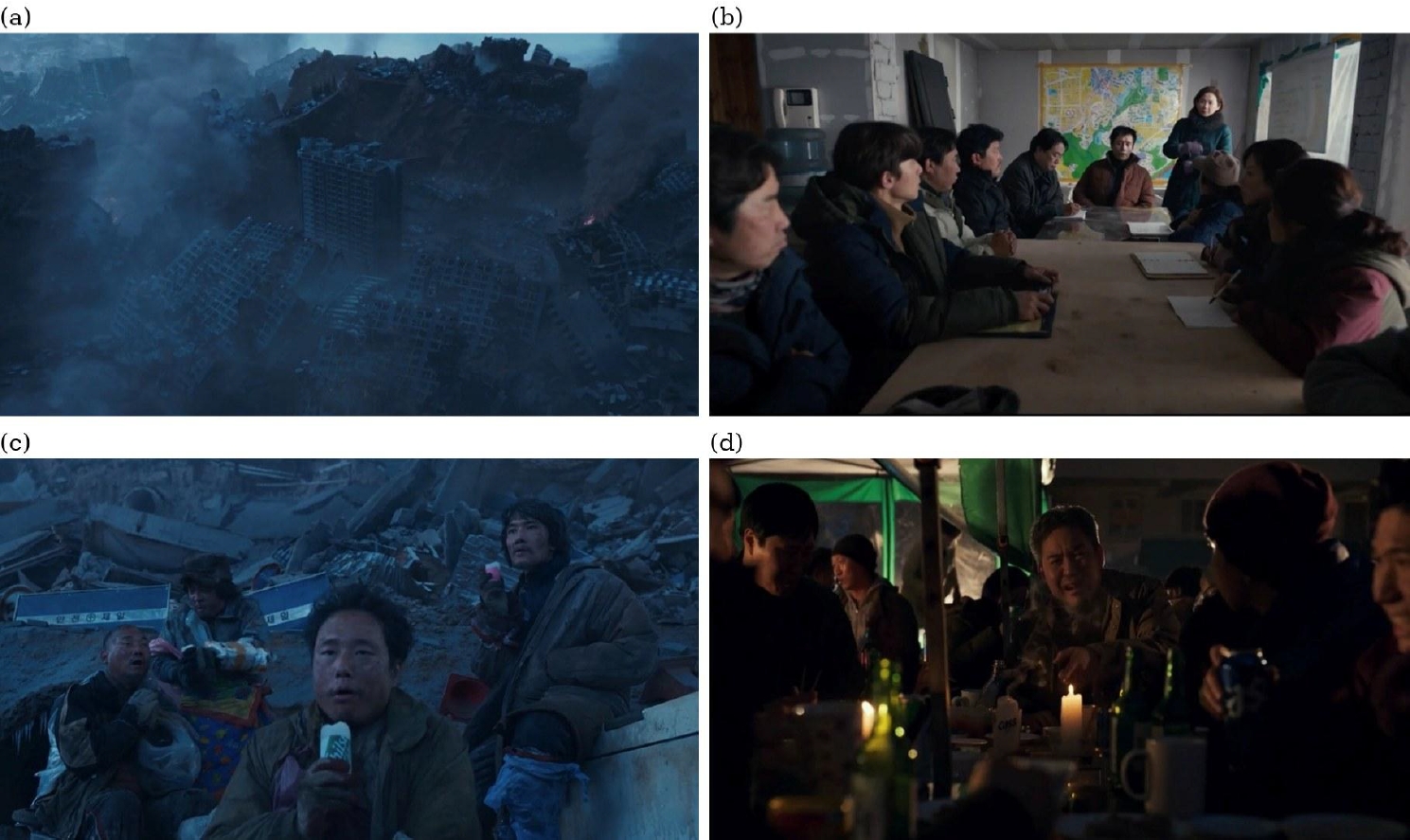
Figure 2.
The Opening Montage: A Compressed History of the Korean Apartment
Note. Left: Black-and-white footage of apartment blocks in the opening montage (0:01:07). Right: An aerial view of present-day apartment complexes (0:02:22). From Concrete Utopia [Film], by T.-H. Um (Director), 2023, Climax Studio; BH Entertainment. Copyright 2023 by Climax Studio and BH Entertainment.
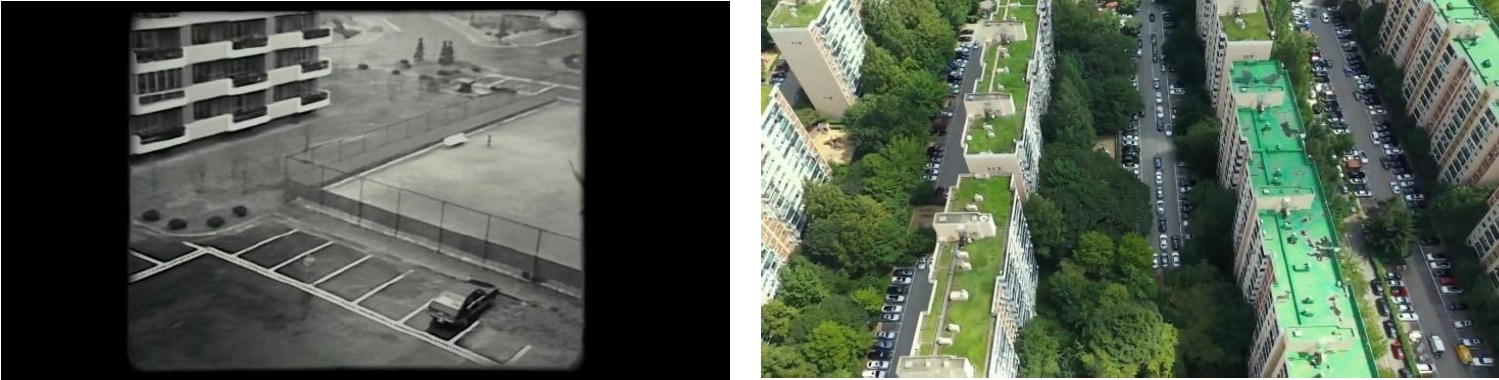
Figure 3.
The Residents’ Feast in the Courtyard
Note. Yeong-tak leads the residents in singing Yun Su-il’s Apartment (1982) at the courtyard feast (1:07:10). From Concrete Utopia [Film], by T.-H. Um (Director), 2023, Climax Studio; BH Entertainment. Copyright 2023 by Climax Studio and BH Entertainment.
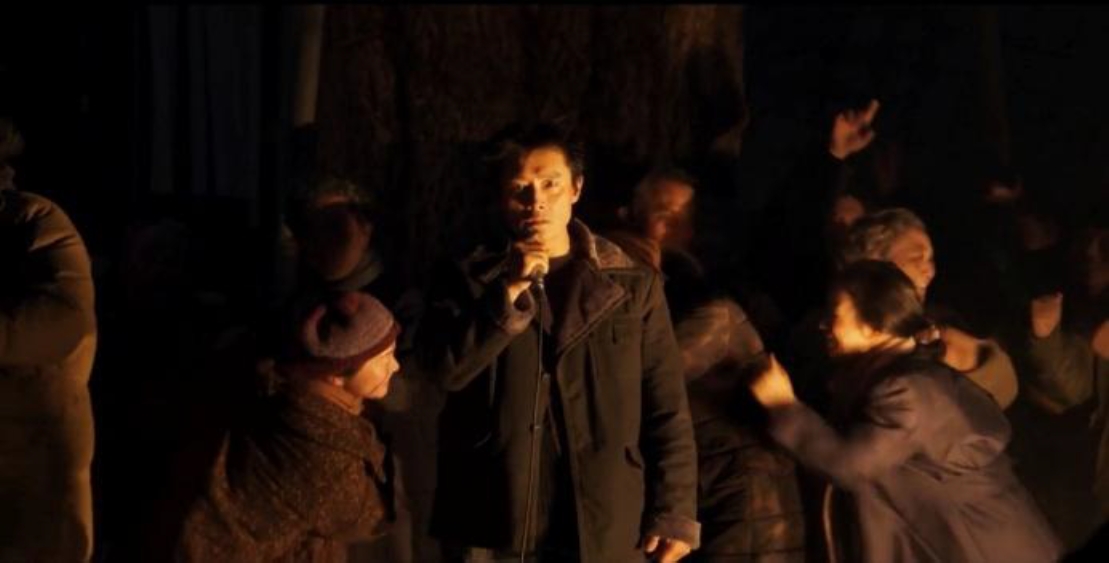
Figure 4.
The Standoff in the Courtyard
Note. The residents face the outsiders with their backs to the apartment (0:32:19). From Concrete Utopia [Film], by T.-H. Um (Director), 2023, Climax Studio; BH Entertainment. Copyright 2023 by Climax Studio and BH Entertainment.
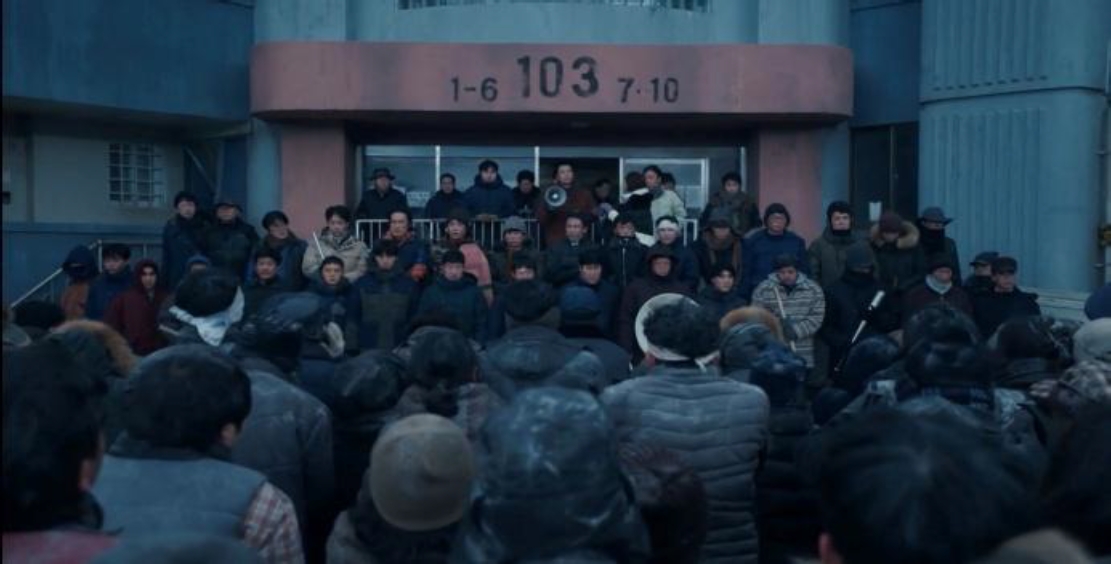
Figure 5.
The Red Mark on the Door of a Household Harboring an Outsider
Note. The entrance of a household found to have hidden an outsider is marked in red paint (1:27:19). From Concrete Utopia [Film], by T.-H. Um (Director), 2023, Climax Studio; BH Entertainment. Copyright 2023 by Climax Studio and BH Entertainment.

Figure 6.
The Hwanggung Apartment Residents’ Code
Note. The first promulgation of the residents’ code (0:41:42). From Concrete Utopia [Film], by T.-H. Um (Director), 2023, Climax Studio; BH Entertainment. Copyright 2023 by Climax Studio and BH Entertainment.

Figure 7.
Yeong-tak Recast as an Outsider
Note. The residents turn on Yeong-tak and subject him to collective violence once his identity as an outsider is exposed (1:48:30). From Concrete Utopia [Film], by T.-H. Um (Director), 2023, Climax Studio; BH Entertainment. Copyright 2023 by Climax Studio and BH Entertainment.
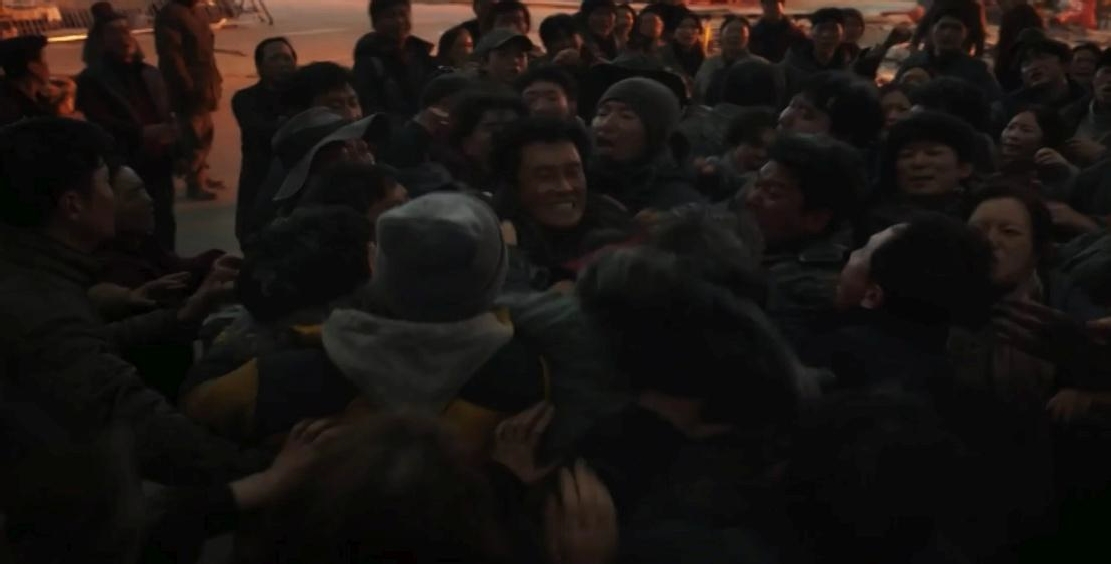
Table 1.Top Naver Verified-Viewer Reviews Containing the Lexicon of Unease, Queasiness, and Realistic
|
Likes |
Date |
Review |
|
1,975 |
2023.08.09 |
A film that poses, less the question of right and wrong, than the question of whom one resembles |
|
1,061 |
2023.08.09 |
Are we not already living just like this |
|
944 |
2023.08.09 |
So realistic it left me queasy |
|
294 |
2023.08.10 |
Queasy once it was over... |
|
275 |
2023.08.11 |
Felt sick to my stomach, truly... even more than watching a zombie film... |
|
231 |
2023.08.19 |
My stomach turned the whole way through. I could not swear that the figure on screen was not myself. (...) It was the unease of having one’s inmost mind found out. |
|
217 |
2023.08.11 |
Uncomfortable and ill at ease the whole time I watched |
REFERENCES
- Baccolini, R. , & Moylan, T. (Eds.). (2003). Science fiction and the dystopian imagination. Routledge.
- Baek, H.-L. (2023). An analysis of storytelling strategy of Korean apocalypse content: Focusing on the OTT dramas Kingdom and Sweet Home. Global Cultural Contents, 57101-115.
- Baek, H.-L. (2024). The politics of space in post-apocalyptic films. Global Cultural Contents, 61137-151.
- Chae, W. (2004). The meaning of naming apartments: From the sociolinguistic viewpoint. The Sociolinguistic Journal of Korea, 12(1), 231-252.
- Chang, K.-S. (2010). South Korea under compressed modernity: Familial political economy in transition. Routledge. https://doi.org/10.4324/9780203854396
- Cho, H.-R. (2025). From Exit to Concrete Utopia: Shifting world-perception in Korean disaster cinema after the COVID-19 pandemic. The Journal of Literary Creative Writing, 24(2), 197-223. https://doi.org/10.47057/jklcw.2025.64.11
- Choi, S.-K. (2022, February 8). A world hooked on ‘apocalypse and zombies’: Is dystopia Korea all right? Daily Good News. https://www.goodnews1.com/news/articleView.html?idxno=404330
- Claeys, G. (2017). Dystopia: A natural history. Oxford University Press.
- Gelézeau, V. (2007). Republic of apartments: Korean apartments seen by a French geographer (H.-Y. Gil, Trans.). Humanitas. (Original work published 2003).
- Han, S. (2019). The political unconscious in Korean disaster films: Based on the 2010s. Mediasociety, 27(2), 98-166.
- Jameson, F. (1991). Postmodernism, or, the cultural logic of late capitalism. Duke University Press.
- Jameson, F. (2005). Archaeologies of the future: The desire called utopia and other science fictions. Verso.
- Jeon, S.-I. (2009). Mad about apartments: A residential sociology of contemporary Korea. Isup.
- Jeong, D.-H. (2021, December 16). The shadow of growth, ‘K-dystopia’. edaily. https://www.edaily.co.kr/News/Read?newsId=01223446629279176&mediaCodeNo=257
- Kang, Y. (2022). Korean survival narrative and K-meritocracy: Focusing on the Netflix original drama Squid Game. Journal of Modern Korean Literature, 23(2), 33-65.
- Kim, B.-R. (2023, August 1). Director Um Tae-hwa: “Concrete Utopia drew inspiration from Picasso’s Guernica.” The Korea Economic Daily. https://www.hankyung.com/article/202308015432i
- Kim, J.-Y, & Yun, S.-K. (2022, February 10). ‘K-dystopia’ laid bare a world without hope. Seoul Shinmun. https://www.seoul.co.kr/news/newsView.php?id=20220211001026
- Kim, M. (2022, February 3). K-dystopia captivates the world. Sports Kyunghyang. https://sports.khan.co.kr/article/202202031625003
- Kim, S. H. (2002). Problem of “space” in semiotic theory of Y. Lotman. Semiotic Inquiry, 11213-244.
- Kim, S. H. (2008). Cultural semiotic approach to the notion of “boundary”: From the principle of demarcation to the mechanism of translation. Semiotic Inquiry, 23489-514.
- Kim, S.-Y. (2023, May 19). Black Knight and the crisis of ‘K-dystopia’. Kyunghyang Shinmun. https://www.khan.co.kr/article/202305190300075
- Korean Film Council. (2023, August 17). Results of the selection of the Korean submission for the International Feature Film category of the 96th Academy Awards [Announcement]. https://www.kofic.or.kr/kofic/business/board/selectBoardDetail.do?boardNumber=4&boardSeqNumber=56583
- Kristeva, J. (1982). Powers of horror: An essay on abjection (L. S. Roudiez, Trans.). Columbia University Press. (Original work published 1980).
- Lee, D. (2025). The dystopian worldview in Korean dramas: Focusing on works produced by global platforms. The Journal of Language & Literature, 102221-246.
- Lee, H.-J. (2012). A.P.T spectacle: Focused on apartment model house as a screen practice. The Korean Journal of Arts Studies, (6), 141-190.
- Lee, H.-J. (2013). A.P.T spectacle: Focused on Korean films in the formation of Seoul as a metropolis in the 1960s and the 1970s. Cultural Studies, 2(1), 175-253.
- Lee, S.-W. (2021, December 15). They are all made in Korea, so why do K-dramas take off while Hallyu dramas stay quiet? SisaIN. https://www.sisain.co.kr/news/articleView.html?idxno=46229
- Lim, M. K., & Lee, D. (2023). K-drama in the time of the pandemic: The production of hope through the subgenre of the K-dystopia. Situations: Cultural Studies in the Asian Context, 16(2), 77-108. https://doi.org/10.22958/situcs.2023.16.2.004
- Lotman, J. M. (1977). The structure of the artistic text (G. Lenhoff & R. Vroon, Trans.). University of Michigan, Department of Slavic Languages and Literatures. (Original work published 1970).
- Lotman, J. M. (1990). Universe of the mind: A semiotic theory of culture (A. Shukman, Trans.). Indiana University Press.
- Lotman, J. M. (2005). On the semiosphere (W. Clark, Trans.). Sign Systems Studies, 33(1), 205-229. https://doi.org/10.12697/SSS.2005.33.1.09 (Original work published 1984)
- Lotman, J. M. (2008). Semiosphere: Cultural studies and cultural semiotics (S. H. Kim, Trans.). Moonji. (Original work published 2000).
- Lotman, J. M. (2009). Culture and explosion. (W. Clark, Trans.; M. Grishakova, Ed.). De Gruyter Mouton. https://doi.org/10.1515/9783110218473 (Original work published 1992)
- Lotman, J. M., & Uspensky, B. A. (1978). On the semiotic mechanism of culture (G. Mihaychuk, Trans.). New Literary History, 9(2), 211-232. https://doi.org/10.2307/468571
- Moylan, T. (2000). Scraps of the untainted sky: Science fiction, utopia, dystopia. Westview Press.
- Noh, H. J. S. (2025). Surviving dystopia: Immersive spectacle as transmedia marketing in Netflix’s K-dramas. Flow, 32(1), https://www.flowjournal.org/2025/10/surviving-dystopia/
- Park, H.-C. (2011). Concrete utopia. Jaeum & Moeum.
- Park, S., & Ryoo, W. (2024). A study on the ‘Koreanness’ represented by Netflix and the multi-layered implications of global K-contents: Focused on the case of Korean remake contents. Korean Journal of Broadcasting and Telecommunication Studies, 38(4), 119-154. https://doi.org/10.22876/kab.2024.38.4.004
- Sargent, L. T. (1994). The three faces of utopianism revisited. Utopian Studies, 5(1), 1-37.
- Skult, P. (2019). The end of the world as we know it: Theoretical perspectives on apocalyptic science fiction [Doctoral dissertation, Åbo Akademi University]. Åbo Akademi University Press.
- Suvin, D. (1979). Metamorphoses of science fiction: On the poetics and history of a literary genre. Yale University Press.
- Um, T.-H. (Director). (2023). Concrete utopia [Film]. Climax Studio; BH Entertainment.
- Yoo, J. J. (2026). Locally global: Entextualizations of the K- morpheme in contemporary Korean popular culture. Signs and Society, 14(2), 211-227. https://doi.org/10.1017/sas.2026.10051