This study explores the polyphonic diversity of technopoetry and sound poetry, tracing their evolution within the expanded field of contemporary art. The 20th century was notably characterized by avant-garde movements—such as Dadaism, Surrealism, Russian Constructivism, Situationism, and Futurism—that influenced the poetic techno-scene. Some notable movements include Fluxus, the happening, and post-punk. These were movements that set powerful trends, finding new avenues of expression—hybridization, transgression, rupture, and the liminal space between the body and the artistic medium—within a constant flow that takes on a philosophical, aesthetic-political-social, and visual construct. Through the incorporation of diverse media and the use of technology, the work acquires a new symbolic dimension, one that originates in poetry and music. This essay briefly explores the symbolic nature of technopoetry and its relationship to related subgenres: experimental, concrete, sound, electronic, and semiotic poetry, as well as videopoetry, holopoetry, and performance poetry. Thereby prompting an examination of the future of poetry and the arts within the context of the 4.0 revolution and the technological convergence involving artificial intelligence and big data.
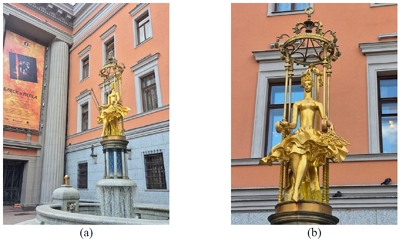
Modern semiotics pays particular attention to the concept of enunciation, particularly markers of subjectivity and polyphonic discourse. The view of enunciation as an act or process has become a central concern of the Paris Semiotic School in recent decades, with the introduction of the categories of "instances of enunciation" (Coquet 1984). The connection between the phenomenon of polyphony and the enunciation in literary texts was noted by Mikhail Bakhtin (1963) and Oswald Ducrot (1984). However, the problem of expressing polyphonic utterances in theatrical contexts remains understudied. Theatrical semiotics represents a special area of the sign world. In theater, "everything is semiotics," from makeup to the stage and the ritualized theatrical atmosphere (Lotman 1989). We propose analyzing theatrical enunciation through the lens of the concept of truth, using the example of the Vakhtangov Theatre's production of Princess Turandot.
Buddhism, once a dominant religious and cultural force in its birthplace of India, experienced a dramatic decline between the 7th and 13th centuries CE, eventually nearly vanishing from the subcontinent. This research examines the multifaceted causes of this "symbolic paradox," analyzing the intersection of external pressures and internal vulnerabilities. External factors included intense competition and strategic absorption into Brahmanical symbolism, in which the Buddha was recast as an avatar of Vishnu, and the decisive military destruction of major monastic universities, such as Nalanda, by Muslims. Internally, Buddhism suffered from sectarian fragmentation, a growing disconnect between monastics and the laity, and a shift toward complex scholasticism that alienated common followers. Despite its retreat from India, Buddhist symbols survived through migration to Tibet, East Asia, and Southeast Asia, and, significantly, through the emergence of Giao Chau Buddhist symbols (Vietnam today) via Tứ Pháp (Four Dharma). This research hypothesizes that although the institutional conditions for Buddhism can be fragile, its core teachings possess resilient symbolism that enables them to re-emerge across diverse cultural and social contexts and in different modes of practice.
This article examines clothing in The Adventures of Tintin from a semiotic perspective, considering dress as a system of signs embedded in the visual logic of comics. Building on Pierre Fresnault-Deruelle’s pioneering studies (1976, 1999, 2002, 2006, 2012) and later contributions by scholars such as Groensteen, Marion, and Floch, the analysis explores how the aesthetics of the ligne claire transform garments into both narrative and symbolic operators. The results identify seven functional categories of dress—core attire, everyday wear, professional/functional outfits, disguises, cultural costumes, ceremonial garments, and altered clothing—which serve as identity anchors, indicators of action, or markers of cultural otherness. Tintin’s consistent base attire ensures visual coherence, while subtle variations introduce narrative nuance and contextual adaptation. The study concludes that clothing in Hergé’s work is far from decorative; it functions as a central semiotic device whose stability and transformations reinforce the character’s iconicity and his status as a timeless cultural hero.



 First
First Prev
Prev