Buddhism, once a dominant religious and cultural force in its birthplace of India, experienced a dramatic decline between the 7th and 13th centuries CE, eventually nearly vanishing from the subcontinent. This research examines the multifaceted causes of this "symbolic paradox," analyzing the intersection of external pressures and internal vulnerabilities. External factors included intense competition and strategic absorption into Brahmanical symbolism, in which the Buddha was recast as an avatar of Vishnu, and the decisive military destruction of major monastic universities, such as Nalanda, by Muslims. Internally, Buddhism suffered from sectarian fragmentation, a growing disconnect between monastics and the laity, and a shift toward complex scholasticism that alienated common followers. Despite its retreat from India, Buddhist symbols survived through migration to Tibet, East Asia, and Southeast Asia, and, significantly, through the emergence of Giao Chau Buddhist symbols (Vietnam today) via Tứ Pháp (Four Dharma). This research hypothesizes that although the institutional conditions for Buddhism can be fragile, its core teachings possess resilient symbolism that enables them to re-emerge across diverse cultural and social contexts and in different modes of practice.
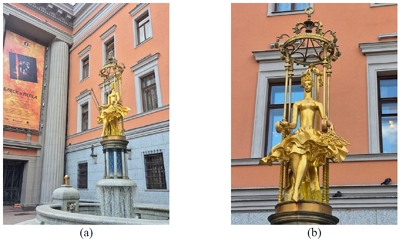
Modern semiotics pays particular attention to the concept of enunciation, particularly markers of subjectivity and polyphonic discourse. The view of enunciation as an act or process has become a central concern of the Paris Semiotic School in recent decades, with the introduction of the categories of "instances of enunciation" (Coquet 1984). The connection between the phenomenon of polyphony and the enunciation in literary texts was noted by Mikhail Bakhtin (1963) and Oswald Ducrot (1984). However, the problem of expressing polyphonic utterances in theatrical contexts remains understudied. Theatrical semiotics represents a special area of the sign world. In theater, "everything is semiotics," from makeup to the stage and the ritualized theatrical atmosphere (Lotman 1989). We propose analyzing theatrical enunciation through the lens of the concept of truth, using the example of the Vakhtangov Theatre's production of Princess Turandot.
It is known that poem"Aryman i Oromaz" is part of the cycle "Eastern Flowers" by the Polish poet. Along with other works of the cycle, which provide poetic translations from Arabic poetry, this poem is dedicated to a fragment from the French translation of the Avesta, describing the history of the creation of the world, the cosmogonic views of the Zoroastrians on the structure of the world. Mickiewicz, who has certain ideas about the content of the sacred book, tries to recreate the primary picture of the religious tradition for the Polish reader. This topic is important for Mickiewicz to assert the thesis of the triumph of good over evil, which is close to him and lived by him. In other words, by addressing the plot of a foreign ancient religion, the poet expresses the identity of the postulates of Zoroastrianism with his life and personal views. Analysis of the text of the work shows that the Polish poet adheres to the plot of the French translation, creating his own vision of the problem, confirming the moral values that follow from the source material. Some elements of the work, reflecting the main concepts of the translated text, suggest that Mickiewicz initially planned to translate the text into Polish, and in the process of translation, individual interpretation took over. Thus, the poem should be perceived as a recreation of the text, interpreted in a new artistic context.
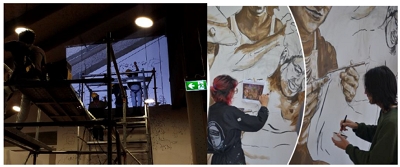
Creating the collective mural “Poemas para no olvidar” -Poems against oblivion- (2025), at the National University of Colombia, brought together the voices, experiences, knowledge, and actions of young university students. It also involved the participation of those who experienced the trauma of forced displacement, in dialogue with those who are emerging and embracing their identity as artists. The mural, as a collective construction of peacebuilding action, is the embodiment of the profound relationship that connects art, memory, polyphony (c.f. Bakhtin, 2013) and symbols of visual culture to, through practice, manage forms of artistic expression capable of consolidating collective memories, identities, and the projection of humanizing futures. This study adopts the framework of Multimodal and Multimedia Critical Discourse Studies (MMCDS), centered on the semiotic axis to explore, from combined theoretical perspectives, how collective memory is questioned, constructed, safeguarded, and transformed through murals, as an expression capable of visually representing indexes, iconologies, and symbols that materialize in art. The analysis takes into account the framework of collective memory, peace action, and participatory art.
This study explores the polyphonic diversity of technopoetry and sound poetry, tracing their evolution within the expanded field of contemporary art. The 20th century was notably characterized by avant-garde movements—such as Dadaism, Surrealism, Russian Constructivism, Situationism, and Futurism—that influenced the poetic techno-scene. Some notable movements include Fluxus, the happening, and post-punk. These were movements that set powerful trends, finding new avenues of expression—hybridization, transgression, rupture, and the liminal space between the body and the artistic medium—within a constant flow that takes on a philosophical, aesthetic-political-social, and visual construct. Through the incorporation of diverse media and the use of technology, the work acquires a new symbolic dimension, one that originates in poetry and music. This essay briefly explores the symbolic nature of technopoetry and its relationship to related subgenres: experimental, concrete, sound, electronic, and semiotic poetry, as well as videopoetry, holopoetry, and performance poetry. Thereby prompting an examination of the future of poetry and the arts within the context of the 4.0 revolution and the technological convergence involving artificial intelligence and big data.
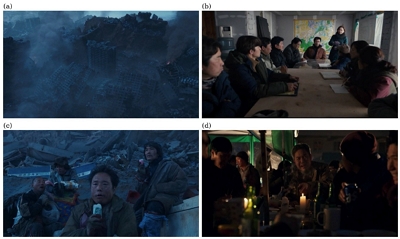
This article analyzes Um Tae-hwa’s Concrete Utopia (2023) through Yuri Lotman’s concepts of spatial modelling, boundary, and the semiosphere, to elucidate how the sign of the apartment constitutes dread within Korean society and to submit the discourse of K-dystopia to critical scrutiny. Reading that discourse as a mode of self-description reorganized under the conditions of transnational circulation and global-platform legibility after the global success of Squid Game (2021), the study attends to the local surplus that such naming fails to carry across, declining nonetheless to consign it to the untranslatable. Two movements compose the argument. Beyond the film, the specificity of the Korean apartment is bound to the discourse of K-dystopia so as to disclose a dread that circulation leaves untranslated; within the film, scene analysis traces the visual codification of interior against exterior, the graduated nullification of the other, and the closure of the boundary through the ossification of self-description. Diegetic exclusion and discursive subsumption prove to be a single semiotic operation nested at two magnitudes, a matryoshka isomorphism in which the recurring unease articulated in Korean viewer reviews may be read as registering the homology of the two. Untranslated dread, so situated, opens onto a productive site of reappropriation and emergence.
The sky has long been read, and the climate crisis has renewed the need to read it. Today, changes in the atmosphere cannot be grasped simply by looking up at the sky; we encounter them through processes of observation, recording, classification, and interpretation. Yet the processes through which such readings are produced often recede behind their results. This study addresses this problem through the concept of environmental legibility, which refers to the process by which atmospheric change becomes perceptible and readable. Drawing on Derrida’s grammatology and on Ingold’s and Böhme’s accounts of atmospheric perception, the study distinguishes two dimensions of inscription. Material-atmospheric inscription refers to physical changes that register as perceptible or measurable differences. Discursive-technical inscription refers to the human and technical practices through which such differences are recorded, classified, and calculated. The legibility of the sky emerges through the interplay of these two dimensions. This interplay is examined through Susan Schuppli’s Can the Sun Lie? (2014) and Trevor Paglen’s CLOUD series (2019). Schuppli foregrounds how atmospheric difference becomes evidence, while Paglen makes visible how visual differences are selected as algorithmic features. Together, the two works show how the sky becomes legible and how the conditions of its reading recede behind the result.




 First
First Prev
Prev